
Field notes · November 6, 2026
Weight-Space Interventions in Model Reasoning Loops
MIT CSAIL researchers repaired reasoning loops in a small language model by editing 0.016% of its weights, raising MATH-500 accuracy from 7.9% to 48.1%. A subsequent community analysis using Anthropic's Jacobian lens revealed the internal t
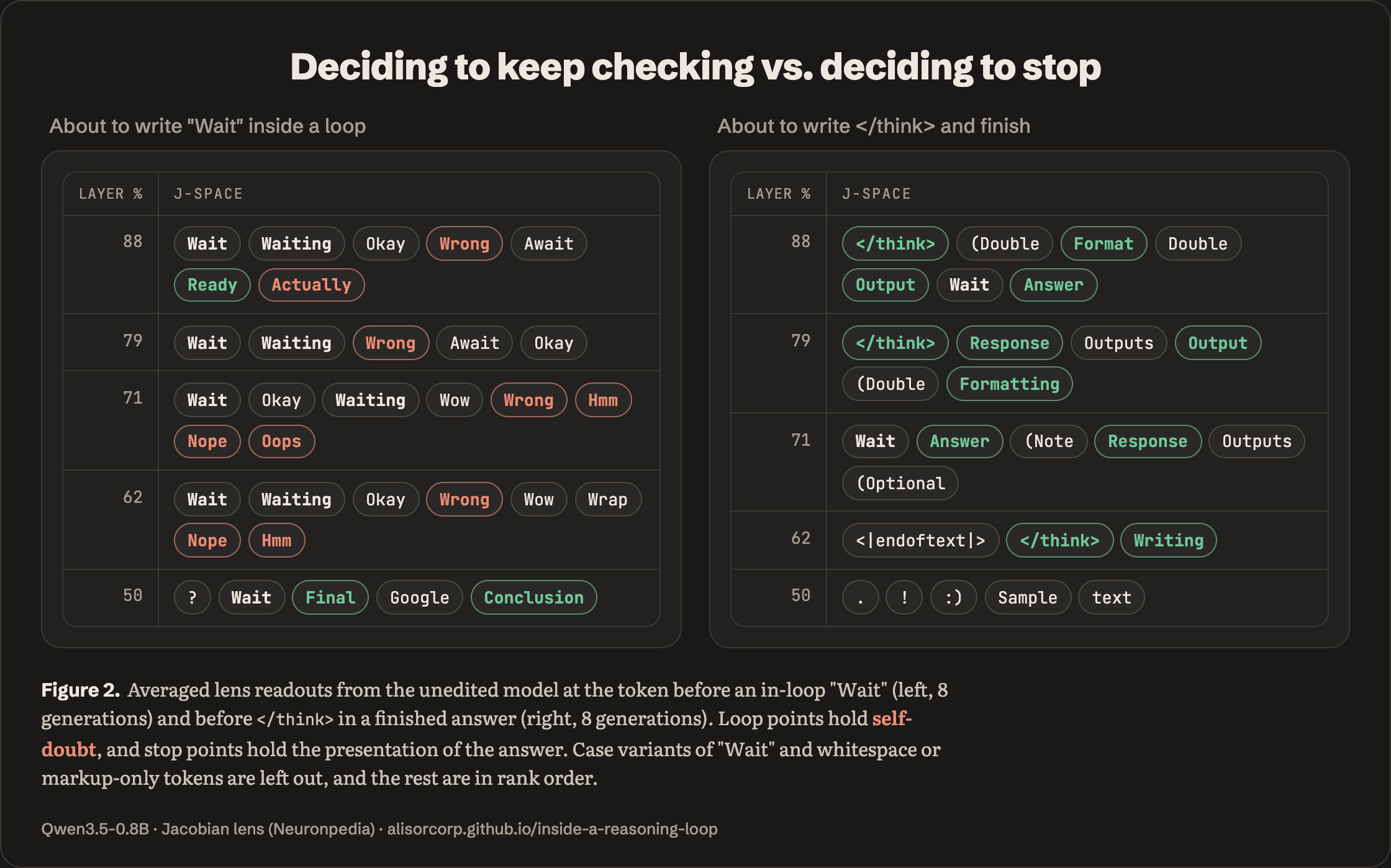
A recent technical development originating from MIT CSAIL and extended by open-source practitioners addresses the phenomenon of reasoning loops in small language models. According to reports shared on the r/LocalLLaMA forum and an accompanying GitHub repository maintained by alisorcorp, researchers at MIT CSAIL used a larger model, identified as GPT-6 Astra, to correct repetitive reasoning failures in Qwen3.5-0.8B. The intervention involved editing precisely 0.016% of the smaller model’s weights. Following this sparse weight-space edit, the model’s performance on the MATH-500 benchmark increased from 7.9% to 48.1%. The research team released the exact weight differential, allowing the modification to be rebuilt and executed locally by other developers. Building upon this release, a community contributor applied Anthropic’s Jacobian lens—a mechanistic interpretability tool designed to analyze how changes in input tokens affect output logits—to examine the internal state of Qwen during a reasoning loop. The analysis focused specifically on the token where the model decides to generate the word "Wait" repeatedly. Under the Jacobian lens, the internal representations at that decision point were read as signaling "Wrong," "Nope," and "Hmm," suggesting that the model is registering an error or uncertainty but lacks the parametric pathway to resolve it, resulting instead in a repetitive textual loop.
The theoretical significance of this event lies in the intersection of mechanistic interpretability and sparse model editing. A reasoning loop occurs when an autoregressive language model enters a degenerate generative cycle, producing identical or near-identical sequences without progressing toward a solution. In standard deployment, such loops are typically managed through external heuristics, such as repetition penalties or maximum generation limits. The MIT CSAIL approach demonstrates that these behavioral failures can be addressed internally through highly localized modifications to the weight space. Editing only 0.016% of the parameters indicates that the capacity for correct mathematical reasoning was already latent within the Qwen3.5-0.8B architecture; the failure was not a total absence of knowledge but a routing error in the model’s computational graph. The dramatic shift in MATH-500 accuracy from 7.9% to 48.1% confirms that removing this specific bottleneck unlocks existing representational capabilities.
Furthermore, the application of the Jacobian lens provides empirical texture to the abstract concept of a model getting "stuck." By mapping the logit gradients at the precise moment of failure, the analysis reveals that the model’s internal state is not blank or random. The activation patterns corresponding to concepts like "Wrong" or "Hmm" indicate a form of internal conflict detection. The model recognizes that its current trajectory is failing, yet the transition probabilities collapse into a narrow loop rather than branching into alternative problem-solving strategies. This suggests that reasoning loops are not merely syntactic accidents but are rooted in specific semantic evaluations that fail to trigger corrective action.
However, the evidence presented carries distinct limitations. First, the scale of the model is exceptionally small. Qwen3.5-0.8B possesses fewer than one billion parameters, making it highly susceptible to brittle failure modes that may not manifest identically in larger, more robust architectures. The success of a 0.016% weight edit in a sub-billion parameter model does not guarantee that similar sparse interventions would yield proportional improvements in models with tens or hundreds of billions of parameters, where reasoning pathways are likely more distributed and redundant. Second, the use of a vastly more powerful model (GPT-6 Astra) to diagnose and repair a weaker one introduces a dependency that limits the generalizability of the method. The technique requires access to a superior oracle model to identify the correct weight differentials, which complicates its utility for improving frontier models where no such oracle exists. Finally, while the Jacobian lens analysis offers compelling qualitative insights into the tokens associated with the loop, interpreting these activations as human-like thoughts (e.g., reading them as "Wrong" or "Hmm") risks anthropomorphism. These labels are projections of human semantic categories onto high-dimensional vector spaces, and their exact functional role in the model's computation remains subject to ongoing debate in mechanistic interpretability.
When considering the implications of these findings for teaching and learning with AI, the connection must be drawn carefully. Educational institutions increasingly explore local, lightweight models for classroom use due to data privacy concerns and infrastructure constraints. Models in the sub-billion parameter range are attractive because they can run on standard consumer hardware. However, the prevalence of reasoning loops in such models poses a significant barrier to their pedagogical reliability. If a student uses a local model for mathematical problem-solving and the model enters a repetitive "Wait" loop, the educational interaction breaks down entirely. The MIT CSAIL result implies that educators and ed-tech developers could potentially curate and patch local models, using released weight diffs to ensure that small, privacy-preserving models remain functionally competent for specific academic tasks without relying on cloud-based APIs.

Additionally, the interpretability findings offer a novel avenue for AI literacy education. Understanding why an AI fails is as pedagogically valuable as observing its successes. The revelation that a model generates repetitive text because it internally registers an error but cannot route around it provides a concrete, demystifying example of machine limitation. Instructors could use tools like the Jacobian lens to show students the internal mechanics of AI hesitation, shifting the student perspective from viewing the AI as an infallible oracle to understanding it as a probabilistic system with identifiable structural flaws. This fosters critical engagement with technology. Nevertheless, until sparse editing techniques are proven stable across diverse educational domains and larger model scales, reliance on patched small models for core instructional delivery should be approached with caution, ensuring that automated reasoning failures do not silently disrupt the learning environment.
Source: What Qwen is thinking when it gets stuck saying "Wait"