
Field notes · November 3, 2026
Usage Rate Reductions and Subscriber Trust in AI Platforms
OpenAI's reduction of usage rates for subscribers has generated significant community backlash, raising questions about platform governance and the reliability of commercial AI services for educational use.
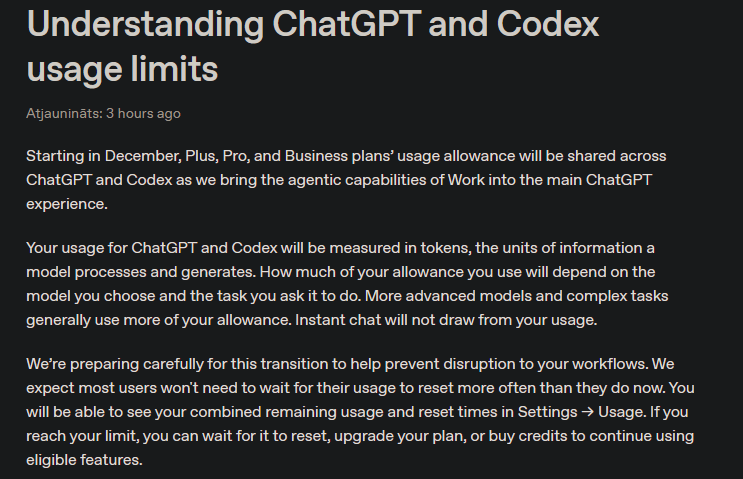
A recent discussion on the r/ChatGPT subreddit, which accumulated 117 comments, highlights substantial user dissatisfaction following an announcement by OpenAI regarding changes to subscriber usage limits. According to the community post, OpenAI announced a reduction in usage rates for its paying subscribers. The author of the post characterizes this change as slashing usage rates and blatantly reducing the value of the subscription without providing any corresponding benefit to the user. The post asserts that the community was rightfully angered by this decision and resolved to make their voices heard. The discussion references OpenAI’s official documentation on understanding ChatGPT and Codex usage limits, located at help.openai.com/lv-lv/articles/20001625-understanding-chatgpt-and-codex-usage-limits, as the primary source material governing these constraints. While the cited help article outlines the parameters of usage limits, the Reddit discussion reflects the user base's interpretation of and reaction to recent modifications in those parameters, specifically framing the reduction as a unilateral devaluation of the paid service.
The theoretical analysis of this event requires examining it through the lens of platform governance and the political economy of digital infrastructure, rather than through pedagogical or cognitive theories. When a dominant artificial intelligence provider alters the terms of access for its users, it engages in a form of infrastructural power. Platform governance theory suggests that the entities controlling digital platforms act as private regulators, establishing the rules, boundaries, and economic conditions under which users operate. In this instance, the modification of usage rates represents a shift in the contractual and practical relationship between the platform provider and the consumer. The backlash documented in the 117 comments illustrates a friction point inherent in centralized platform models: users who build workflows, habits, or dependencies around a specific level of service are highly vulnerable to unilateral changes made by the platform operator. The absence of perceived reciprocal benefits exacerbates this vulnerability, transforming a routine administrative adjustment into a breach of user trust.
However, the evidence provided by the Reddit thread carries inherent limitations. A single subreddit post with 117 comments, while indicative of vocal community sentiment, does not constitute a representative sample of OpenAI’s entire global subscriber base. The discourse is subject to selection bias; users who feel aggrieved by a reduction in service are significantly more motivated to post and comment than those who remain indifferent or unaffected. Furthermore, the post relies on subjective characterizations, such as describing the community as rightfully angered, which frames the narrative emotionally rather than analytically. The referenced OpenAI support article provides the factual basis for the existence of usage limits, but it does not independently verify the specific magnitude of the recent reductions or the corporate rationale behind them. Therefore, while the community reaction is a verifiable social phenomenon, the precise operational details of the rate changes require corroboration from broader industry reporting or official corporate communications beyond the localized help document.
Despite these evidentiary limits, the implications of this event for teaching and learning with artificial intelligence are substantial and warrant serious consideration by educators and institutional administrators. The integration of commercial AI tools into educational environments often assumes a baseline of stability regarding access and capability. When educators design curricula, assignments, or assessment rubrics that rely on students having consistent access to a specific tier of an AI service, they implicitly trust the platform's continuity. A sudden reduction in usage rates disrupts this continuity. If students encounter usage limits mid-assignment or during critical study periods because the platform has restricted their allowable interactions, the pedagogical design fails not due to instructional flaws, but due to external infrastructural instability.
This dynamic introduces a structural inequity into AI-mediated education. Students who can afford higher-tier subscriptions or multiple accounts may circumvent the newly imposed limits, while those relying strictly on the reduced standard subscription face immediate barriers to participation. Consequently, the platform's governance decisions directly influence educational equity. Educators must therefore critically evaluate the risks of tethering essential learning outcomes to proprietary platforms governed by fluctuating commercial interests. The reliance on a single provider for core educational activities creates a dependency that leaves both instructors and learners exposed to arbitrary policy shifts.
Furthermore, this event underscores the necessity of institutional strategies that mitigate platform risk. Educational institutions exploring AI integration must consider diversification—utilizing multiple AI providers, investing in open-source local models where feasible, or negotiating enterprise agreements that guarantee stable access levels insulated from consumer-tier fluctuations. The Reddit discussion serves as a practical case study in the fragility of consumer-facing AI services. It demonstrates that the terms of engagement are not static and that the value proposition of a subscription can be altered unilaterally by the provider. For the field of educational technology, this reinforces the argument that AI tools should be treated as volatile resources rather than permanent fixtures. Pedagogical frameworks incorporating these tools must include contingencies for sudden access restrictions, ensuring that learning objectives can still be met even when the underlying technological infrastructure contracts. Ultimately, the community response to OpenAI's usage rate adjustments highlights the tension between corporate resource management and user expectation, a tension that becomes particularly acute when the affected users are engaged in structured educational endeavors.