
Agent systems · October 5, 2026
The Thought Before the Action: How ReAct Planning Shapes AI Tutors
This essay explains how the ReAct framework interleaves reasoning and tool use in AI agents, and what that architecture means for teachers deploying autonomous tutors. It is written for educators and researchers who want to understand the mechanics behind AI planning in learning environments.
This essay examines how AI tutoring agents plan their actions by interleaving internal reasoning with external tool use, a technical process that directly shapes student learning. It is written for teachers and educational researchers who need to understand the mechanical foundations of autonomous AI systems before integrating them into classroom practice.
When a human tutor sits down with a struggling reader, they do not simply blurt out the next sentence of instruction. They pause. They look at the student’s face, recall what happened five minutes ago, decide whether to offer a hint or ask a question, and then act. This loop of thinking and doing happens so fast it feels seamless. For an artificial intelligence agent to replicate this dynamic, it requires a formal architecture that separates thought from action while keeping them tightly synchronized. The most influential model for achieving this in modern language agents is the ReAct framework, introduced in the paper "ReAct: Synergizing Reasoning and Acting in Language Models." Understanding how ReAct works is essential for anyone evaluating or designing AI tools for education, because the way an agent plans determines whether it acts as a thoughtful guide or a reckless answer engine.

Interleaving Thought and Action
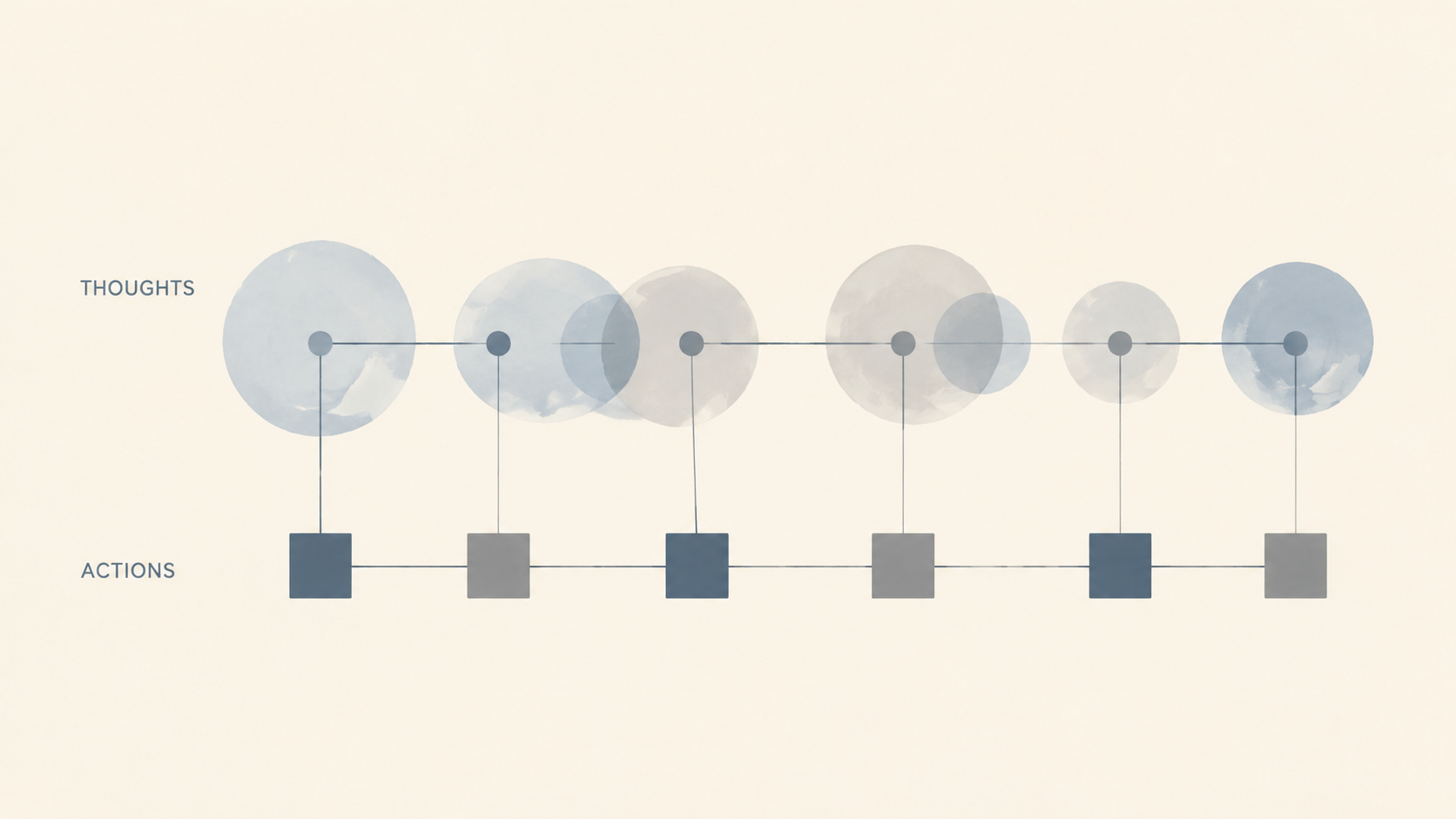
At its core, the ReAct framework addresses a fundamental limitation of large language models: when left to generate text continuously without stopping to consult outside information, they tend to hallucinate facts or lose track of complex goals. ReAct solves this by forcing the model to alternate between two distinct modes. First, it generates a "reasoning trace," which is essentially a chain of thought where the model talks to itself about what it needs to do next. Second, it executes an "action," such as querying a database, running a calculator, or retrieving a specific document. After the action returns a result, the model generates another reasoning trace to interpret that result before deciding on its next step.
In an educational context, this interleaving is what allows an AI agent to function as a planner rather than just a chatbot. Imagine a student asks an AI tutor to help them understand the causes of the American Civil War. A system without structured planning might immediately generate a long, unverified summary. A ReAct-based agent, however, begins with a reasoning trace. It might internally note that the student previously struggled with economic concepts, and therefore decide to focus on the economic differences between the North and South first. Its subsequent action might be to query a verified curriculum database for an appropriate reading passage. Once the passage is retrieved, the agent reasons again, deciding how to frame a guiding question based on the text, before finally generating a response for the student.
This separation of reasoning and acting gives developers and educators visibility into the agent's decision-making process. Because the reasoning traces are explicit, they can be logged and reviewed. If the tutor makes a pedagogical error—perhaps offering a hint that is too advanced—a researcher can look back at the reasoning trace to see exactly why the agent made that choice. This transparency is vital for building trust in educational technology.
Learning from Failure Through Verbal Reflection
Planning in AI agents is not static; it must improve over time. This is where the concept of memory intersects with planning. The paper "Reflexion: Language Agents with Verbal Reinforcement Learning" introduces an architecture that allows AI agents to learn from their mistakes without requiring traditional machine learning retraining. Instead of updating the underlying neural network weights every time an error occurs, Reflexion uses episodic memory and verbal self-reflection.
When a Reflexion-equipped agent fails a task—for example, if it provides a math explanation that leads the student to an incorrect answer—it generates a textual reflection on why it failed. This reflection is stored in the agent's memory. The next time the agent faces a similar problem, it retrieves this past reflection during its initial reasoning phase. It essentially reminds itself, in natural language, not to repeat the previous error.
For teachers and researchers, this mechanism is significant because it mirrors how human educators develop their craft. A teacher remembers a lesson that fell flat and adjusts their approach the following year. Reflexion gives AI agents a rudimentary version of this professional memory. However, it also introduces complexity. If an agent's verbal reflection is flawed—if it misdiagnoses why a student was confused—it will store and retrieve bad advice, compounding the error over time. Therefore, the quality of the agent's planning depends entirely on the accuracy of its self-evaluation.
The Policy Context for Autonomous Planning
As AI agents become more capable of independently planning multi-step learning pathways, the role of the teacher shifts from delivering content to overseeing autonomous systems. This shift carries profound ethical and practical implications. The UNESCO publication "Artificial Intelligence in Education: Promises and Implications for Teaching and Learning" provides necessary guardrails for this transition. The report emphasizes that while AI can personalize learning, the deployment of autonomous agents in classrooms must be governed by strict pedagogical and ethical standards.
When an AI agent uses a framework like ReAct to plan a sequence of interventions for a student, it is making decisions that affect that student's educational trajectory. UNESCO stresses that these systems must remain transparent and accountable. Teachers cannot be expected to oversee an agent whose planning logic is hidden inside a black box. The explicit reasoning traces generated by ReAct-style architectures align well with this requirement, as they provide a record of the agent's choices. Furthermore, UNESCO highlights the necessity of keeping human educators in the loop. An AI agent should plan and suggest, but the ultimate authority over a student's learning pathway must remain with a qualified teacher who understands the social and emotional context of the classroom—factors that no reasoning trace can fully capture.
Ultimately, the technical principle of interleaved reasoning and acting is not just a computer science curiosity. It is the architectural foundation that determines whether an AI tutor behaves responsibly. By understanding how these agents plan, retrieve memories of past errors, and execute actions, educators can better evaluate the tools entering their schools. The goal is not to let the machine teach blindly, but to ensure that when it acts, it has thought carefully first.