
Agent theory · October 3, 2026
The Group Mind at Work: Socially Shared Regulation and AI in the Classroom
When students collaborate, they must regulate their thinking together. AI agents can support this process by prompting groups to plan, monitor, and reflect as a unit rather than as isolated individuals.
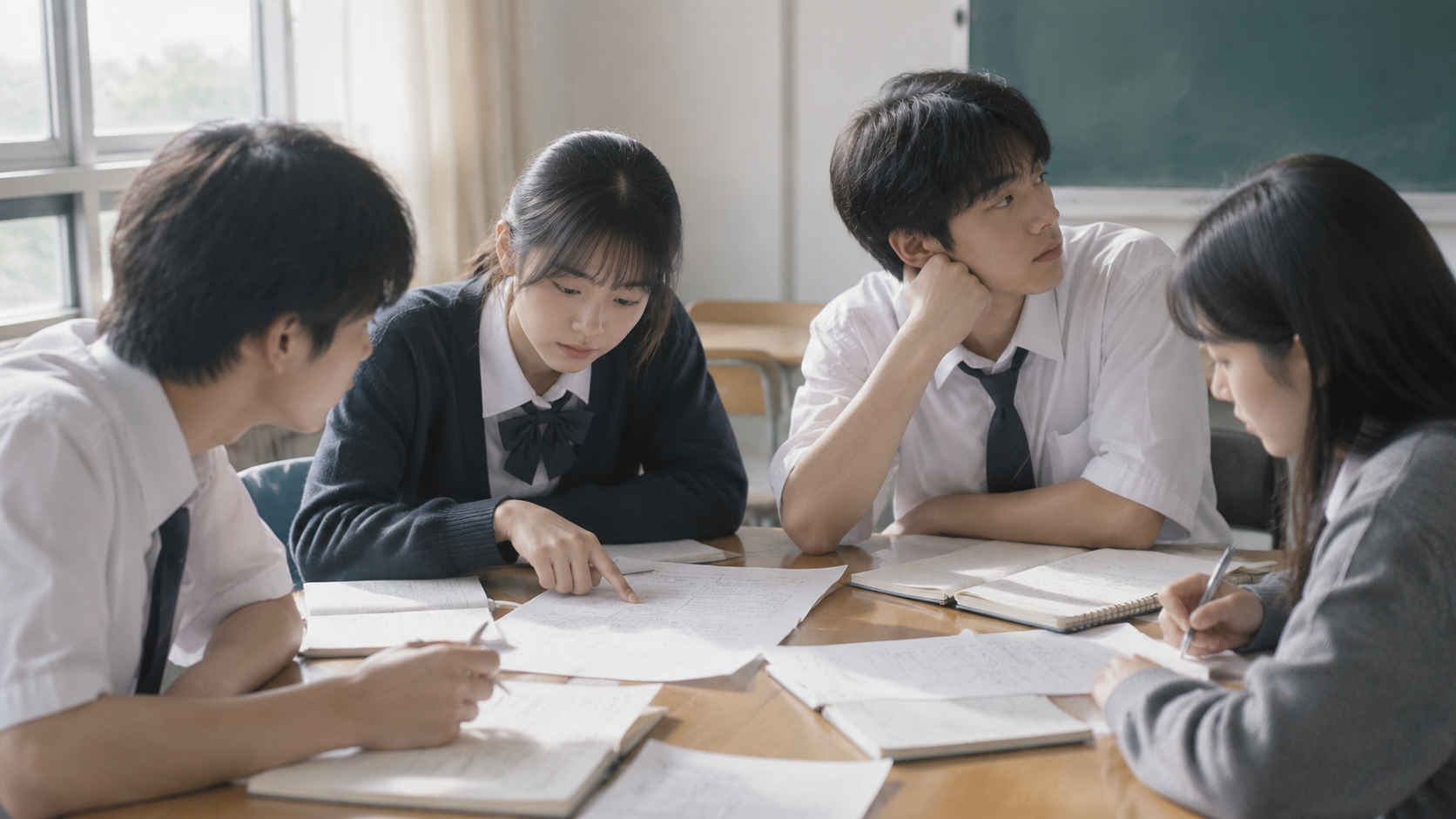
Put four students around a table, give them a complex problem, and watch what happens. One student might rush ahead. Another might disengage. A third might try to organize the group but lack the vocabulary to do so. Teachers know that collaboration is not automatically productive. Simply placing students in a group does not guarantee that they will think well together. They need to manage their shared attention, negotiate their goals, and evaluate their progress as a collective. In educational psychology, this process is known as socially shared regulation of learning.
As AI agents enter classrooms—serving as tutors, teaching assistants, or coordinators of group work—they encounter this messy reality. An AI agent that only responds to individual queries misses the fundamental dynamics of collaborative learning. To be genuinely useful in a classroom where students work together, an AI system must be designed with an understanding of how groups regulate their own cognition. The theory of socially shared regulation offers a concrete framework for building such systems, shifting the focus from the individual mind to the group process.
From Self-Regulation to Shared Regulation
For decades, educational technology focused on self-regulated learning: helping a single student plan, monitor, and reflect on their own work. But when learning becomes a group activity, regulation must also become a group activity. The article "Socially shared regulation of learning: A review" defines this shift clearly. Socially shared regulation occurs when group members collectively manage their cognitive, motivational, and behavioral processes. It is not just one student telling others what to do. It is a mutual, interdependent process where the group develops a shared understanding of the task, monitors its joint progress, and adapts its strategies together.
This distinction matters immensely for AI design. If an AI tutor treats a group project as four parallel individual projects, it fails to support the actual work of collaboration. The research on computer-supported collaborative learning environments reinforces this point. The literature review "Regulation of learning in CSCL environments: A literature review" examines how digital tools can scaffold these regulatory processes among students working together. It highlights that without deliberate support, groups often struggle to coordinate their efforts. Students may fail to notice when they are misunderstanding each other, or they may persist with a flawed strategy because no one steps back to evaluate the group’s overall direction. AI agents positioned within these environments have the potential to intervene precisely when these breakdowns occur, provided they are programmed to recognize group-level dynamics rather than just individual errors.

Scaffolding the Group Process
How exactly can an AI agent support socially shared regulation? The answer lies in metacognitive scaffolding. The research paper "Metacognitive scaffolds for self-regulated learning in computer-based learning environments" investigates how digital prompts can help learners plan, monitor, and reflect. While much of this work originated with individual learners, the underlying mechanics apply directly to groups. A scaffold is not an answer; it is a structure that supports thinking. In a collaborative setting, an AI agent can offer scaffolds that prompt the entire group to pause and align.
Consider the planning phase of a group task. Before students begin writing code or drafting an essay, an AI coordinator could prompt the group to articulate a shared goal. Instead of asking, "What is your plan?" to each student individually, the agent might ask the group, "Has everyone agreed on the first step?" This simple prompt forces a moment of collective negotiation. During the monitoring phase, the AI might track the group's output and notice that they have spent twenty minutes on a minor detail while ignoring the main rubric. The agent could then intervene with a prompt like, "Your group has focused heavily on the introduction. How does this align with your overall objective?" This mirrors the kind of intervention a skilled teacher makes when circulating the room, but it scales to every group simultaneously.
Reflection is the final phase where AI scaffolding proves valuable. After a task is completed, groups rarely take time to evaluate how they worked together. An AI agent can structure this reflection by asking targeted questions about the group's process. Did the group divide the work effectively? Did anyone feel unheard? By prompting these reflections, the AI helps students internalize the habits of socially shared regulation, making them better collaborators over time.
The Teacher, the Agent, and the Group
Integrating AI into collaborative learning does not remove the teacher from the equation; it changes their role. When an AI agent handles the routine prompting required for socially shared regulation, the teacher is freed to address deeper conceptual misunderstandings or interpersonal conflicts that an algorithm cannot navigate. The literature on computer-supported collaborative learning suggests that technology is most effective when it complements human instruction rather than replacing it. An AI agent can serve as a persistent, patient prompter, ensuring that no group goes entirely off the rails, while the teacher focuses on the nuanced moments that require human judgment.
However, designing these agents requires caution. Prompts that are too frequent become noise. If an AI interrupts a group every two minutes to ask if they are regulating their learning, it destroys the very flow it aims to protect. The scaffolds must be adaptive, triggered by genuine indicators of dysregulation—such as prolonged silence, repetitive errors, or conflicting outputs—rather than operating on a rigid timer. The evidence from research on metacognitive scaffolds shows that timing and context determine whether a prompt helps or hinders.
Ultimately, the promise of AI in education is not just personalized tutoring for the solitary learner. It is the capacity to support the complex, dynamic process of people thinking together. Socially shared regulation of learning provides the theoretical architecture for this work. By understanding how groups plan, monitor, and reflect collectively, developers and educators can build AI agents that do more than deliver information. They can build agents that help students learn how to learn together, turning a crowded classroom into a coordinated community of inquiry.