
Field notes · October 25, 2026
Student Surveys on AI Coding Tools and Confidence
A Semester IV college research project surveys students anonymously on how AI coding tools such as ChatGPT, GitHub Copilot, and Gemini affect learning to code and student confidence. This log examines the theoretical implications of measuri
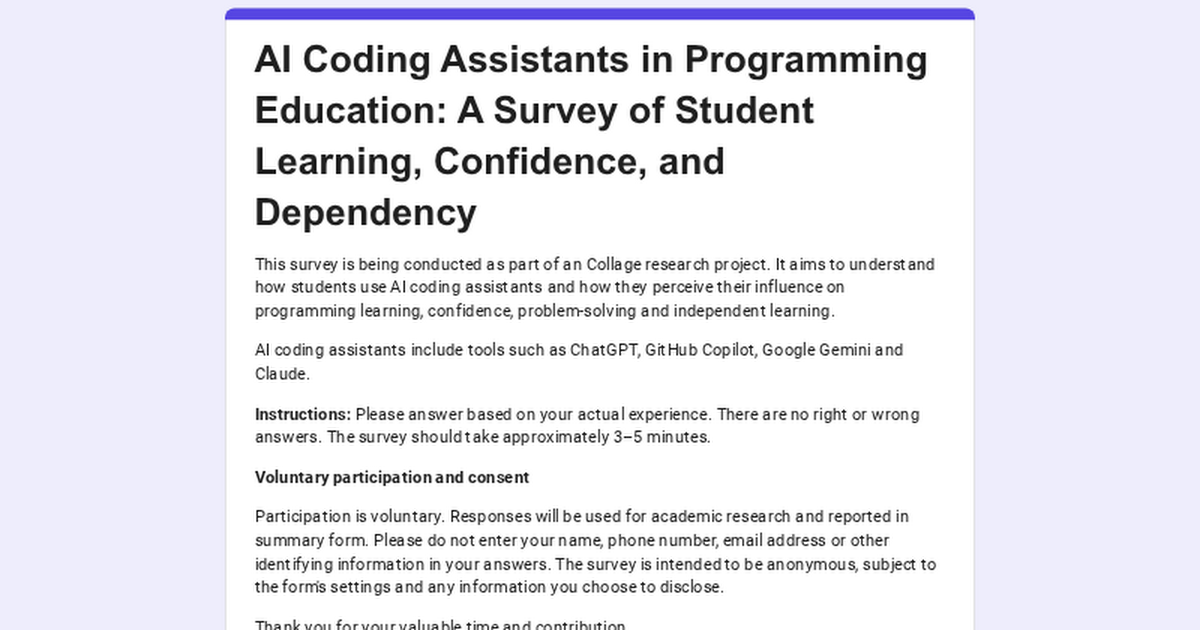
A recent call for participants posted on the r/artificial subreddit solicits responses for a brief, anonymous survey designed by a fourth-semester college student. The stated purpose of the research project is to investigate how artificial intelligence coding tools—specifically naming ChatGPT, GitHub Copilot, and Gemini—affect two distinct variables: the process of learning to code and the level of student confidence. The survey instrument is hosted on a public forms platform, requires no personally identifiable information such as names or email addresses, and is estimated to take between three and five minutes to complete. The researcher explicitly frames the data collection as purely academic. While the post itself does not contain empirical results, it documents an active effort within higher education to gather primary data on the intersection of generative AI tools and novice programmer development. The specific pairing of learning outcomes with psychological constructs like confidence highlights a growing recognition among student researchers that technical proficiency alone does not capture the full impact of AI integration in computer science education.
The decision to measure both learning to code and student confidence reflects an implicit understanding that these two constructs, while related, operate through different mechanisms. In educational psychology, confidence in one’s ability to execute a task is formally understood through the lens of self-efficacy, a concept central to Albert Bandura’s social cognitive theory. Self-efficacy refers to an individual's belief in their capacity to organize and execute the courses of action required to manage prospective situations. When applied to programming education, self-efficacy dictates how much effort a student will expend when encountering a syntax error, how long they will persist when debugging complex logic, and whether they will attempt advanced algorithmic challenges or retreat to simpler tasks. AI coding assistants introduce a novel variable into this dynamic. By providing immediate syntactic corrections, generating boilerplate code, and offering natural language explanations of complex functions, tools like GitHub Copilot or ChatGPT can artificially lower the barrier to producing working software. This reduction in friction may elevate a student's reported confidence, but the mechanism driving that elevation requires careful theoretical scrutiny.
There are at least two distinct pathways through which AI coding tools might influence student confidence, and distinguishing between them is critical for interpreting survey data of the kind being collected. The first pathway is genuine competence building. If a student uses an AI assistant to explain a misunderstood concept—such as the difference between pass-by-value and pass-by-reference—and subsequently internalizes that explanation, the resulting increase in confidence is grounded in actual cognitive growth. The AI tool functions as an informational resource that accelerates comprehension. The second pathway is what might be termed illusory confidence. If a student relies on an AI tool to generate functional code without understanding the underlying logic, they may experience a temporary boost in confidence because the external output is successful. However, this confidence is decoupled from internalized knowledge. When the student is later placed in an environment without AI assistance, such as a proctored examination or a whiteboard interview, the discrepancy between their perceived ability and their actual ability becomes apparent, often leading to acute frustration and a collapse in self-efficacy.
The evidence gathered through a brief, three-to-five-minute anonymous survey possesses inherent methodological limits. Self-reported confidence is highly susceptible to bias, particularly social desirability bias, even when anonymity is guaranteed. Students may overestimate their learning gains or conflate the ease of using an AI tool with their own mastery of the material. Furthermore, cross-sectional survey data captures a single moment in time and cannot easily disentangle whether high confidence preceded the use of AI tools or was caused by them. Students who already possess higher baseline self-efficacy in mathematics or logic may naturally gravitate toward AI coding tools more effectively than their peers, creating a selection effect that complicates causal claims. Without longitudinal tracking or objective performance metrics—such as standardized coding assessments administered with and without AI access—survey responses regarding learning outcomes remain subjective perceptions rather than verified pedagogical facts.
Despite these evidentiary constraints, the impulse to study confidence alongside technical skill carries significant implications for teaching and learning with AI. If educators only assess the final code produced by students, they miss the psychological architecture of learning. A curriculum that integrates AI coding tools must therefore be designed not merely to produce working software, but to ensure that the student's interaction with the AI builds durable self-efficacy. This requires instructional designs where AI tools are used deliberately for reflection rather than mere generation. For example, instead of allowing students to accept AI-suggested code completions passively, instructors might require students to annotate AI-generated code, predict its behavior before execution, or intentionally introduce bugs for the AI to help them trace. These practices force the student to remain the cognitive agent in the loop, ensuring that the confidence they report in surveys is anchored in verifiable understanding rather than dependency.
The existence of this undergraduate research project also signals a broader cultural shift within computer science education. Students themselves are recognizing that the introduction of large language models into their workflow is altering their psychological relationship with their discipline. They are asking whether they are truly learning to code or simply learning to prompt. By operationalizing these questions into measurable survey variables, student researchers contribute to a necessary feedback loop. For institutions aiming to integrate AI responsibly, acknowledging that student confidence is a malleable construct—one that can be either authentically developed or superficially inflated by AI tools—is the first step toward designing assessments and pedagogies that prioritize deep, enduring computational literacy over shallow, tool-dependent output.
Source: Need 3 mins of your time! Quick anonymous survey on AI coding tools for my college project