
Field notes · October 26, 2026
Smart Quantization and Local AI Deployment in Schools
ISTA-DASLab released DeepSeek-V4.1-Flash-1017 using a GSQ-RCO quantization method, but local inference via llama.cpp remains blocked pending architecture support merges. This log examines the technical constraints of deploying advanced mixt
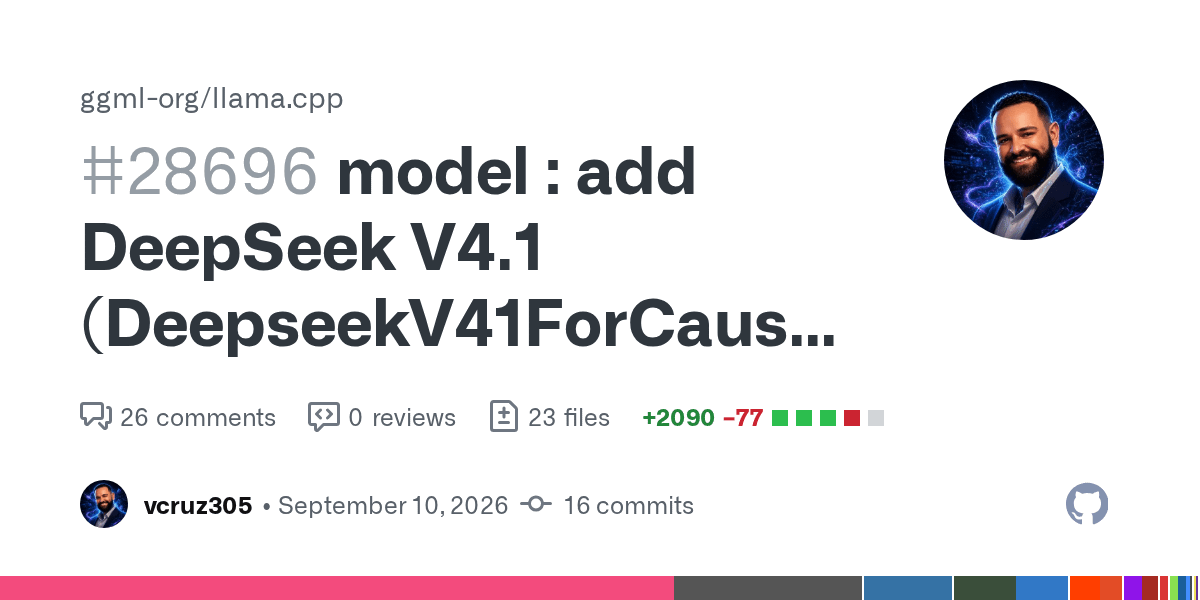
A recent release from ISTA-DASLab introduces a quantized version of the DeepSeek-V4.1-Flash-1017 model utilizing a technique designated as GSQ-RCO smart quantization. According to community reports originating from the r/LocalLLaMA forum, which generated sixty-six comments upon publication, this release represents a novel approach to compressing large-scale language architectures for more efficient deployment. However, the practical utility of this specific model artifact is currently constrained by software infrastructure limitations. The primary open-source inference engine for local execution, llama.cpp, does not yet support running this quantized model. As documented in the source notes, the original architecture support required for DeepSeek-V4.1-Flash has not been merged into the main llama.cpp repository. Specifically, two pull requests—numbered 28696 and 30817 on the ggml-org GitHub repository—are cited as pending prerequisites for functional compatibility. Furthermore, while the official model card associated with the release mentions support for a framework or feature referred to as Strata, community analysis suggests that the original Strata implementation may only provide partial or incomplete support for this specific architectural configuration. Consequently, despite the theoretical advancements in compression represented by the GSQ-RCO method, educators and researchers cannot currently execute this model locally using standard open-source toolchains.
The theoretical significance of this event lies at the intersection of model compression mathematics and distributed systems engineering, specifically regarding how educational institutions might eventually host large artificial intelligence models on local hardware. The mechanism underlying GSQ-RCO, described as a smart quantization approach, pertains to the mathematical reduction of numerical precision within a neural network's weight matrices. Standard large language models typically store weights in sixteen-bit or thirty-two-bit floating-point formats. Quantization algorithms map these high-precision values to lower-bit representations, such as eight-bit integers or specialized mixed-precision formats, thereby drastically reducing the memory footprint and computational bandwidth required during inference. The designation of this method as 'smart' implies an adaptive or non-uniform allocation of bits across different layers or parameters of the network, likely preserving higher precision for mathematically sensitive components while aggressively compressing redundant ones. For Mixture-of-Experts architectures like the DeepSeek V4 series, this process is particularly complex because the model contains numerous sparse sub-networks where only a fraction of parameters are activated per token. Quantizing such sparse structures without degrading the routing mechanisms that select specific experts requires highly specialized algorithmic interventions.
However, the limits of the current evidence must be rigorously acknowledged. The available information consists primarily of community commentary and repository metadata rather than peer-reviewed empirical benchmarks detailing the exact perplexity degradation or task-specific accuracy loss introduced by the GSQ-RCO method on this particular model. Without standardized evaluation metrics comparing the quantized DeepSeek-V4.1-Flash-1017 against its unquantized baseline across established educational or reasoning benchmarks, the true efficacy of the 'smart' quantization remains theoretically promising but empirically unverified in this specific context. Additionally, the ambiguity surrounding the Strata support mentioned in the model card highlights a frequent challenge in open-source machine learning: documentation often outpaces verified software integration. The reliance on unmerged pull requests (28696 and 30817) further illustrates that the availability of a compressed model file is functionally meaningless without the corresponding inference engine updates required to parse its specific tensor layouts and architectural graph.
When the link between advanced quantization techniques and local execution environments becomes fully realized, the implications for teaching and learning with artificial intelligence are substantial. Currently, deploying state-of-the-art Mixture-of-Experts models in educational settings generally necessitates reliance on external application programming interfaces hosted by major commercial providers. This dependency introduces persistent concerns regarding student data privacy, recurring financial costs, and the requirement for stable, high-bandwidth internet connectivity—resources that are frequently inequitably distributed across school districts. If methods like GSQ-RCO successfully compress these massive architectures to fit within the random access memory constraints of standard institutional hardware, such as typical classroom laptops or localized school servers, it enables a paradigm of disconnected, private artificial intelligence tutoring and assistance.
This shift toward viable local deployment alters the pedagogical dynamics of human-computer interaction in the classroom. When an artificial intelligence system operates entirely on local infrastructure, the latency associated with network round-trips to remote data centers is eliminated, allowing for fluid, real-time interactive feedback loops essential for complex problem-solving tasks. More importantly, local execution ensures that student queries, drafts, and intellectual explorations remain within the physical boundaries of the institution's network. This architectural reality mitigates the surveillance risks inherent in cloud-based educational technology, potentially fostering a more secure environment for students to engage in iterative, trial-and-error learning processes without the apprehension of their data being harvested for external model training. Nevertheless, the current bottleneck demonstrated by the llama.cpp merge delays serves as a critical reminder that innovations in algorithmic compression must be synchronously matched by developments in inference software engineering. Until the open-source ecosystem integrates the necessary architectural support, the pedagogical promise of running advanced, efficiently quantified models locally in schools remains suspended in the transitional space between theoretical capability and practical deployment.