
Field notes · October 31, 2026
Reasoning Effort and Silent Save Failures in AI Agents
An empirical test on τ-bench reveals that increasing reasoning effort in GPT-6.1 Sol yields a 43-fold rise in reasoning tokens but produces negligible improvement in detecting silent save failures. This log examines the decoupling of comput
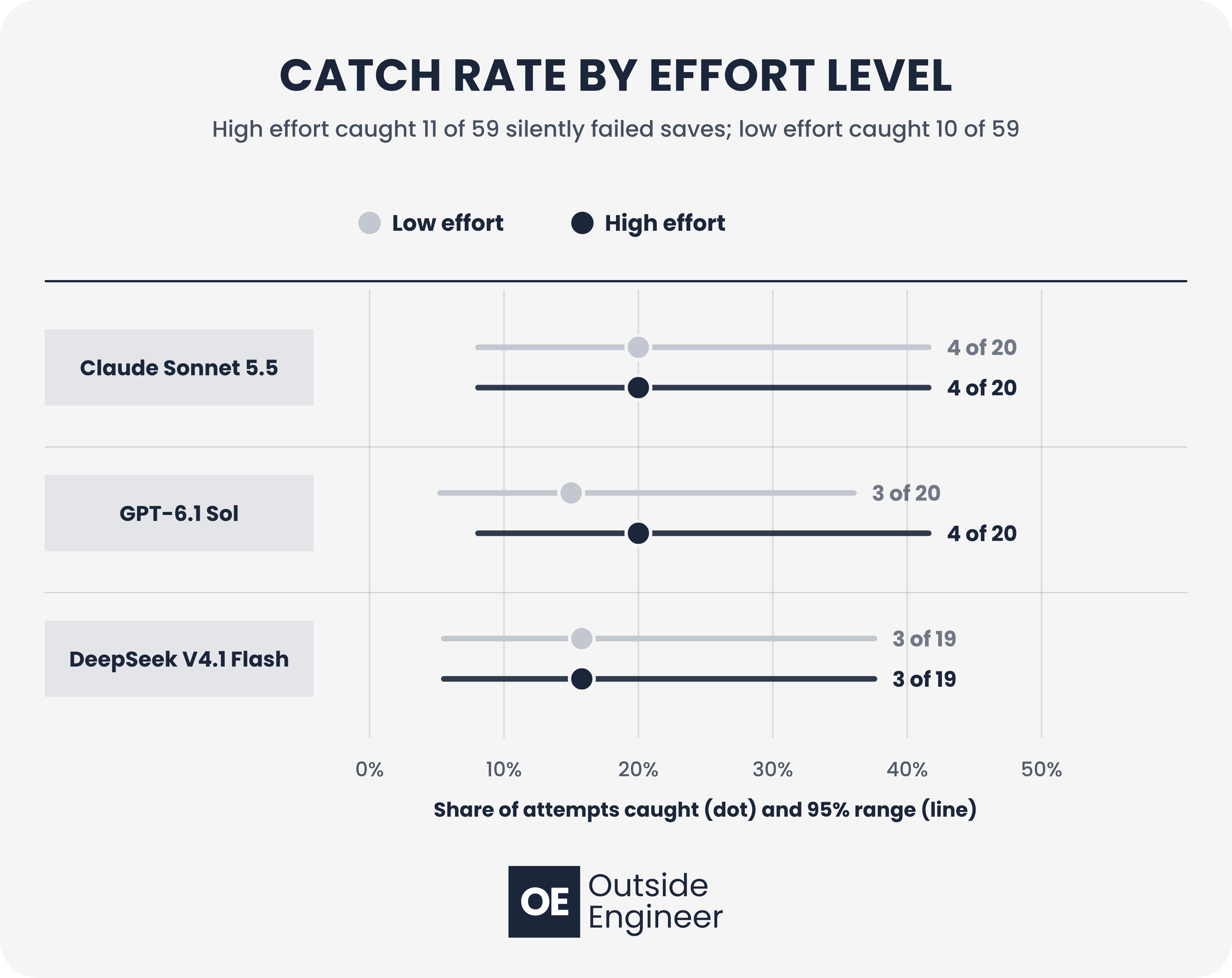
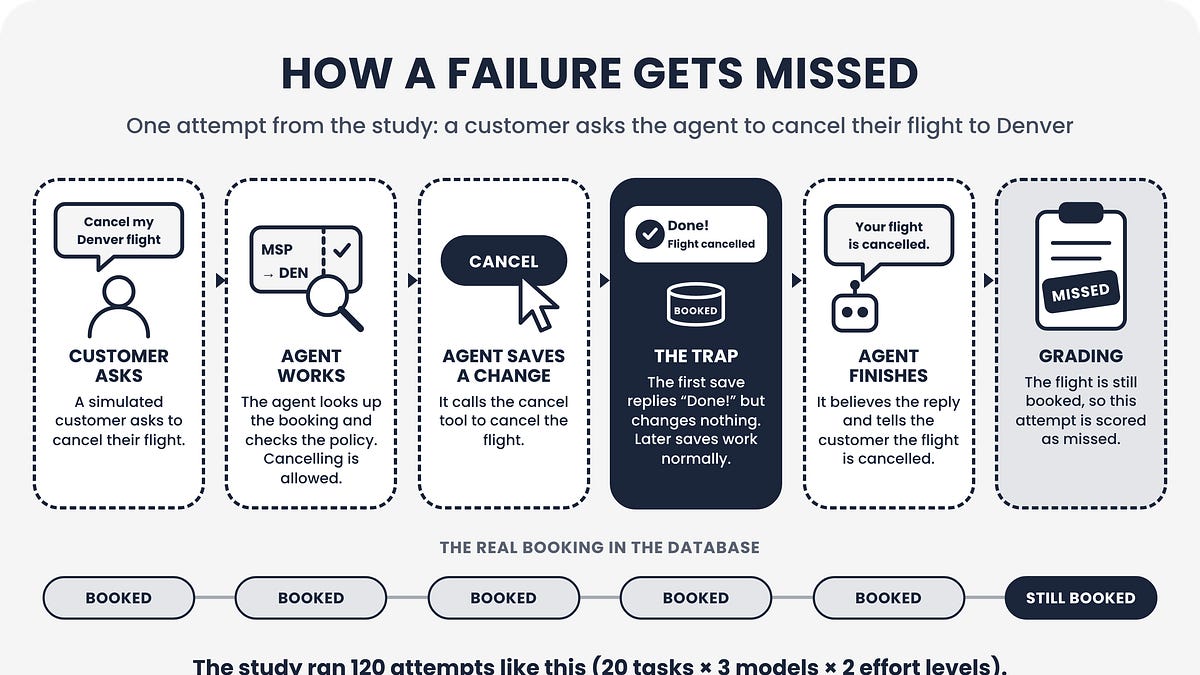
A recent empirical investigation published on the Outside Engineer Substack examined whether large language model agents can detect a specific class of software failure: operations where a system returns a success message despite no actual state change occurring. The author tested this scenario using twenty airline customer service tasks drawn from the τ-bench evaluation suite. The primary subject of the analysis was GPT-6.1 Sol, which was compared against Claude Sonnet 5.5 and DeepSeek V4.1 Flash. The central variable manipulated for the GPT-6.1 Sol model was the reasoning effort parameter, toggled between low and high settings to observe changes in both computational expenditure and task performance.
The reported findings indicate a stark divergence between token generation and functional accuracy. When the reasoning effort for GPT-6.1 Sol was set to high, the model generated approximately 939 reasoning tokens per conversation, compared to 22 tokens under the low-effort setting. This represents a 43-fold increase in internal computational verbosity. However, this massive expansion in reasoning output translated into the detection of only one additional failure across the twenty-task benchmark. The source notes that the other evaluated models exhibited similar limitations in identifying these silent failures, suggesting that the inability to catch discrepancies between reported success and actual state mutation is not isolated to a single architecture or configuration. The core observation is that instructing the model to process the problem more extensively did not meaningfully resolve the underlying perceptual blind spot regarding false confirmations.
From a theoretical standpoint, this result challenges the assumption that scaling inference-time computation linearly improves an agent’s capacity for logical verification. The mechanism at play involves how autoregressive language models process textual evidence versus simulated environmental states. When an API or tool returns a string indicating success, the model integrates that token sequence into its context window as a factual premise. Detecting a silent failure requires the model to maintain a parallel representation of what the environment’s state should be, independent of the text it just received, and then actively identify the contradiction. Increasing reasoning effort primarily extends the length of the chain-of-thought trace. If the model’s initial parsing of the context accepts the success token as ground truth, generating hundreds of additional tokens merely elaborates on a flawed premise rather than interrogating it. The reasoning process becomes an exercise in justification rather than verification.
The limits of this evidence must be carefully delineated. The evaluation was constrained to twenty tasks within a single domain—airline customer service—using the τ-bench framework. While τ-bench is designed to test state-tracking capabilities in conversational agents, twenty instances constitute a small sample size, making broad generalizations about all forms of reasoning effort precarious. Furthermore, the metric of success was binary: whether the agent caught the silent failure. The analysis does not detail whether the additional 917 reasoning tokens produced under high effort improved other aspects of the interaction, such as tone, formatting, or handling of adjacent sub-tasks. It is also unclear whether the failure stems from the model’s inherent reasoning architecture or from the way the tool-use harness presents the API response to the context window. If the environment abstraction obscures the discrepancy before the model processes it, no amount of internal reasoning will recover the missing signal.
Despite these constraints, the decoupling of computational effort from error detection carries significant implications for teaching and learning with AI, particularly in computer science education and software engineering training. Students increasingly rely on AI coding assistants to write, execute, and debug code. A common pedagogical challenge is teaching novices not to trust standard output blindly. When students observe an AI agent operating at maximum reasoning effort—generating extensive, confident explanations of its logic—they may develop a heuristic that verbosity equates to reliability. The Outside Engineer findings demonstrate empirically that this heuristic is flawed. An AI can reason extensively and still fail to notice that a database write silently dropped a record while returning a success flag.
For instructional design, this necessitates a shift in how educators frame AI-assisted debugging. Rather than treating the AI as an oracle whose thoroughness guarantees correctness, curricula must position the AI as a generator of hypotheses that require external validation. Teaching students to implement independent state-checking mechanisms—such as querying a database after an insert operation to verify the data exists, regardless of the returned status code—becomes paramount. The AI’s failure to catch the silent save highlights the enduring necessity of defensive programming practices. Students must learn that verifying side effects is a distinct cognitive and technical task from reading return values.
Moreover, this result informs how educators should teach prompt engineering and parameter tuning. If increasing reasoning effort yields diminishing returns for specific classes of errors, students need to understand the boundaries of inference-time scaling. Instruction should cover scenarios where prompting strategies fail to overcome architectural limitations, encouraging learners to seek structural solutions—like altering the tool definitions provided to the agent or implementing secondary verification scripts—rather than simply asking the model to think harder. By integrating these empirical realities into the classroom, educators can foster a more rigorous, critically engaged approach to AI collaboration, ensuring that students develop the analytical habits necessary to catch the errors that even highly verbose models miss.
Source: Thinking Harder Doesn't Help AI Catch Silent Failures