
Field notes · October 24, 2026
Policy Enforcement in AI Coding Agents via SCOPE
The SCOPE framework addresses the gap between test-passing behavior and policy adherence in AI coding agents. This log examines its mechanism, evidentiary limits, and implications for teaching software engineering with generative AI.
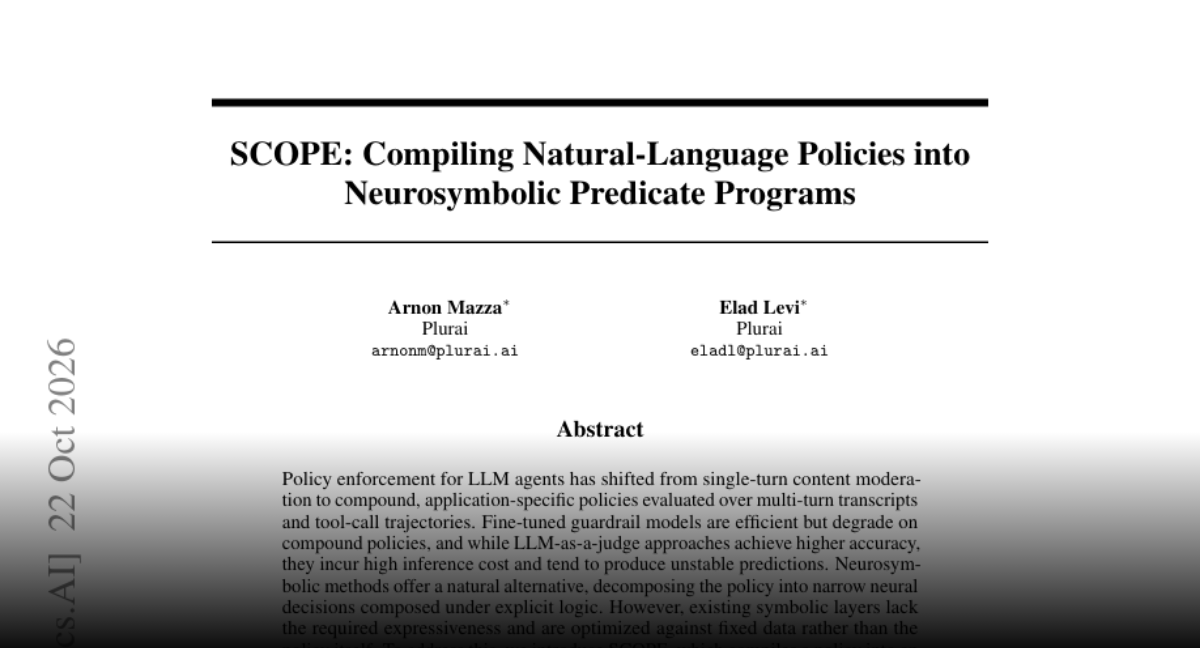
A recent paper titled SCOPE, shared on Hugging Face and discussed within the r/LocalLLaMA community, introduces a framework designed to enforce policies within AI coding agents such as Claude Code and Codex. The research addresses a specific operational friction observed by practitioners: the standard workflow of providing project instructions to an agent, allowing it to generate changes, reviewing the resulting code, and running tests is insufficient for guaranteeing that the agent has actually followed the given instructions. As noted in the community discussion surrounding the paper, passing automated tests does not necessarily mean the agent adhered to the stylistic, architectural, or security constraints specified by the user. The SCOPE framework proposes a method to bridge this gap, moving beyond functional correctness to ensure that generated code complies with explicit policy directives.
The theoretical mechanism underlying SCOPE rests on the distinction between functional verification and constraint satisfaction in automated code generation. When a large language model operates as a coding agent, its primary optimization target during inference is typically aligned with producing syntactically valid code that satisfies the immediate functional requirements of a prompt. Automated test suites serve as the standard feedback loop for this process; if the tests pass, the output is deemed acceptable. However, software engineering involves numerous non-functional requirements—coding standards, modularity constraints, dependency restrictions, and security protocols—that are rarely captured in unit tests. SCOPE intervenes by introducing a structured policy enforcement layer. Rather than relying solely on the generative model's internal alignment or the user's manual review to catch deviations, the framework formalizes these instructions into verifiable policies. By decoupling the evaluation of functional correctness (test passing) from the evaluation of instruction adherence (policy compliance), SCOPE creates a dual-verification architecture. The agent must not only produce working code but also satisfy a set of deterministic or semi-deterministic rules defined prior to or alongside the generation task.
The limits of the current evidence regarding SCOPE warrant careful academic consideration. First, the discourse available at this stage is primarily derived from a preprint hosted on Hugging Face and anecdotal practitioner observations on forums like r/LocalLLaMA, rather than extensive, peer-reviewed longitudinal studies across diverse educational or industrial environments. Consequently, the empirical robustness of the framework's enforcement mechanisms remains subject to further validation. Second, there is an inherent tension in how policies are defined and evaluated. If the policy enforcement relies on rigid, rule-based static analysis, it may fail to capture nuanced architectural intentions that require semantic understanding. Conversely, if the enforcement itself relies on another large language model acting as a judge, the system inherits the same hallucination and alignment vulnerabilities present in the generating agent. Third, the computational overhead introduced by continuous policy checking during the agentic loop could alter the latency and cost profiles of using tools like Codex or Claude Code, factors that are critical when deploying these systems at scale or in resource-constrained settings. Finally, the existing discussion highlights the problem—tests passing without instruction adherence—but comprehensive benchmarks quantifying exactly how often state-of-the-art agents violate implicit versus explicit policies remain underdeveloped.
Despite these evidentiary boundaries, the conceptual contribution of SCOPE carries significant implications for teaching and learning software engineering with artificial intelligence. In educational contexts, the integration of AI coding agents has fundamentally altered the student workflow. Students frequently use these agents to scaffold their programming assignments, relying on the test-driven development cycle to verify their progress. However, computer science pedagogy emphasizes not merely the production of functioning software, but the cultivation of disciplined engineering practices. When students learn that passing tests equates to success, they may inadvertently adopt a paradigm where the structural quality of the code is subordinated to its runtime behavior. SCOPE provides a theoretical and practical countermeasure to this pedagogical risk.
By implementing policy enforcement frameworks in educational AI tools, instructors can ensure that students interact with agents under strict engineering constraints. For example, an instructor might define policies that prohibit the use of certain libraries, mandate specific design patterns, or enforce strict documentation standards. Under a SCOPE-like architecture, the AI agent would be prevented from submitting a solution that passes the functional tests but violates these pedagogical constraints. This shifts the role of the AI agent from a black-box solution generator to a constrained collaborator that forces the student to engage with the principles of software design.
Furthermore, the framework offers a valuable lens for teaching students about the limitations of automated testing itself. A core competency in modern software engineering education is understanding what tests cannot prove. By exposing students to scenarios where an AI agent produces test-passing code that fails policy checks, educators can concretely demonstrate the difference between functional correctness and systemic reliability. This realization encourages students to develop more rigorous code review habits and to view AI-generated outputs critically rather than accepting them based solely on green checkmarks in a continuous integration pipeline.
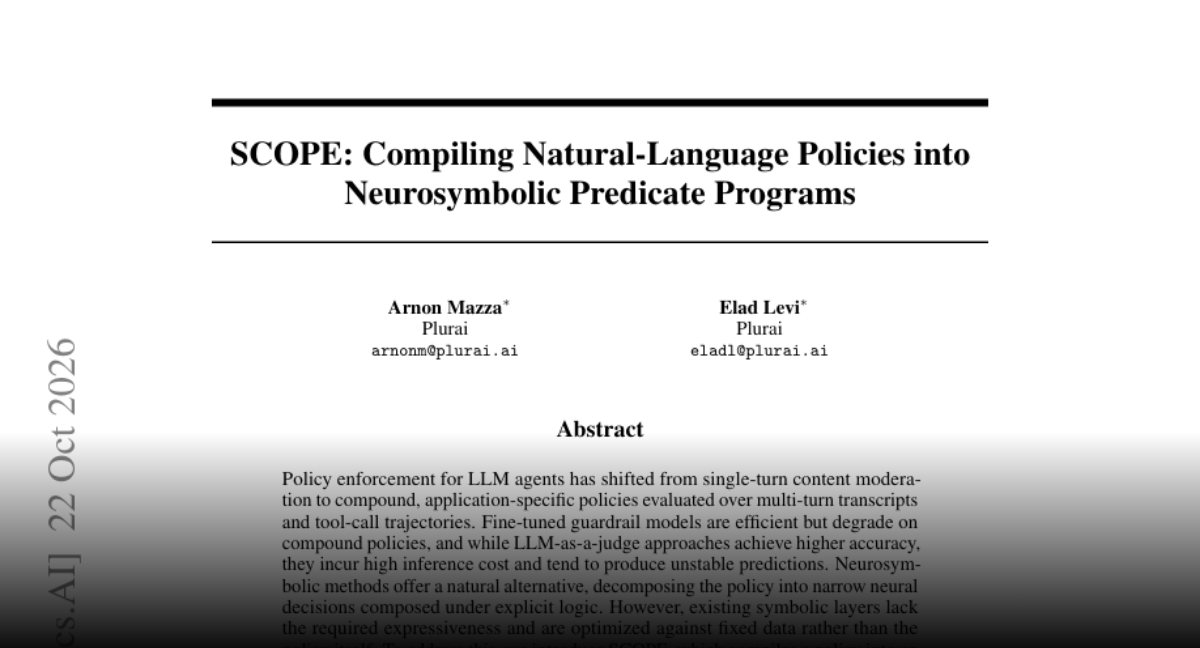
Ultimately, the introduction of SCOPE highlights a maturation in how the field approaches AI coding agents. It acknowledges that raw generative capability is insufficient for professional or educational software development without robust governance mechanisms. For NexEd and the broader educational technology sector, the trajectory suggested by this research points toward a future where AI tutors and coding assistants are not evaluated merely on their ability to solve problems, but on their capacity to solve problems within the precise boundaries set by human instructors and institutional standards. This ensures that the deployment of AI in programming education reinforces, rather than erodes, the foundational disciplines of computer science.