
Field notes · November 7, 2026
Open-Weights Dominance in Aggregated Inference Traffic
Aggregated routing data indicates that open-weights laboratories now account for over seventy-five percent of daily inference tokens, with a single model family generating more than half the total volume. This distribution suggests a struct
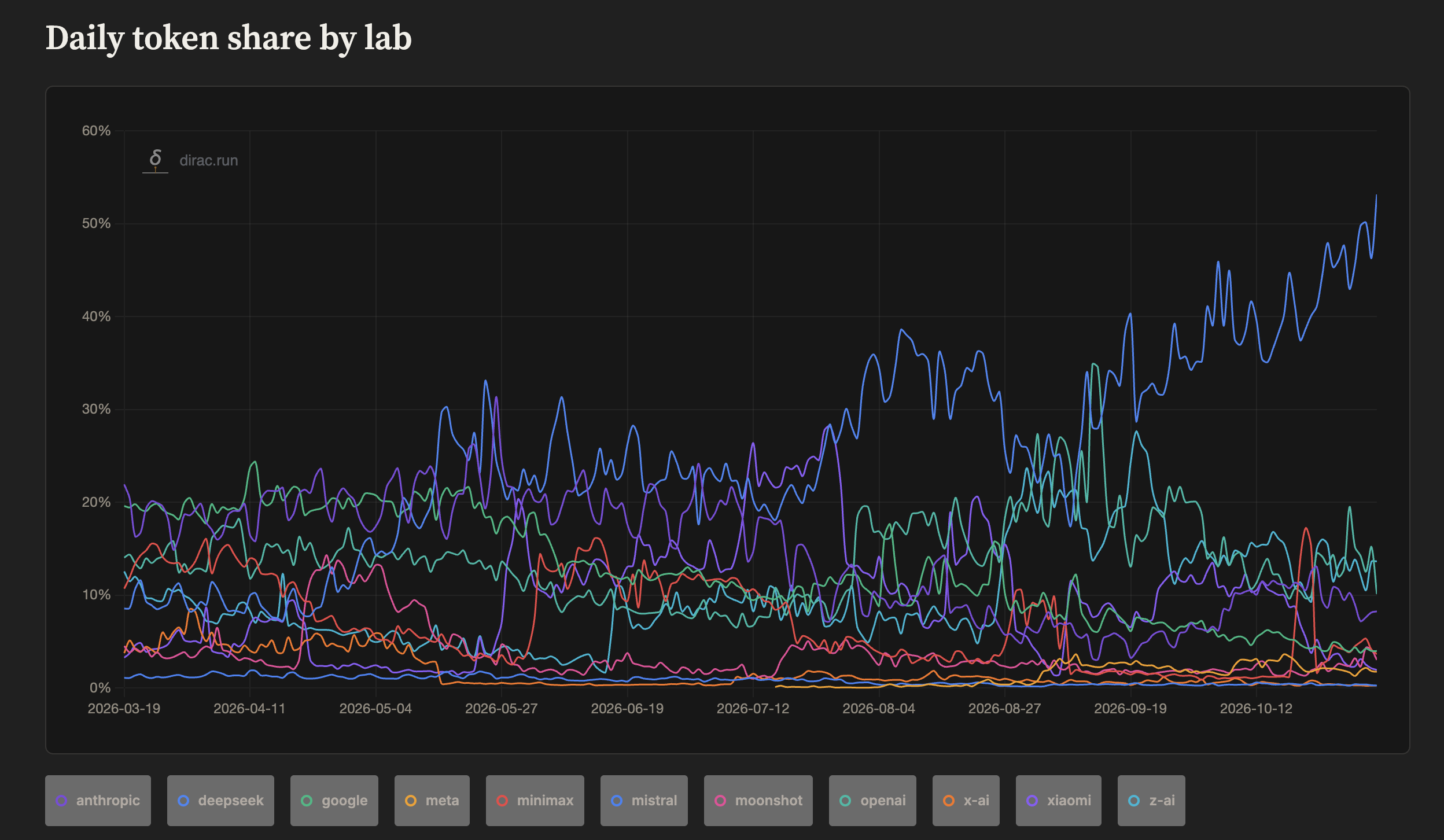
A dataset published by Dirac Labs, which tracks daily token consumption routed through the OpenRouter aggregation platform, reports a pronounced concentration of inference traffic among open-weights artificial intelligence laboratories. According to the data, DeepSeek alone accounted for fifty-three percent of all tokens processed on the platform during a single observed day, a period in which the total volume reached twenty-seven trillion tokens. When aggregated across all providers classified as open-weights laboratories, the combined share exceeded seventy-five percent of the total daily token volume. The source presents these figures as a continuous market-share metric, tracking the proportion of inference requests directed toward different foundational model providers via a unified routing interface. The discussion surrounding this data, which generated ninety-three comments on the r/LocalLLaMA community forum, reflects significant interest among practitioners regarding the shifting balance between proprietary and openly distributed models in high-volume deployment environments.
The mechanism underlying this distribution is rooted in the architecture of inference routing platforms and the economic incentives governing model selection. OpenRouter functions as an intermediary layer that standardizes application programming interfaces across multiple model providers, allowing developers to switch between proprietary and open-weights models without altering their application code. When a single open-weights model family captures more than half of the total token volume on such a platform, it indicates that developers are systematically selecting that model for production workloads. The primary mechanisms driving this selection are cost efficiency, latency optimization, and permissive licensing. Open-weights models, particularly those released under licenses that allow commercial use and modification, eliminate the vendor lock-in associated with proprietary application programming interfaces. Furthermore, because the weights are publicly available, these models can be hosted on decentralized infrastructure or optimized through techniques such as quantization, further reducing the marginal cost per token. The twenty-seven trillion token figure represents an aggregate measure of computational demand, suggesting that the models capturing the majority of this demand are being utilized for tasks requiring massive throughput, such as batch processing, synthetic data generation, or high-frequency user interactions.
However, the evidence presented by the Dirac Labs tracker possesses distinct limitations that must be acknowledged before generalizing its implications. First, the data is exclusively derived from traffic routed through OpenRouter. While OpenRouter is a prominent aggregation service, it does not capture the totality of global inference traffic. Direct integrations with proprietary providers, enterprise deployments behind corporate firewalls, and local inference executed entirely on consumer hardware without an intermediary router are absent from this dataset. Consequently, the seventy-five percent figure represents the share within a specific routing ecosystem rather than a definitive measure of the global artificial intelligence market. Second, token volume is not synonymous with user count, revenue, or task complexity. A small number of automated pipelines executing bulk data processing can generate trillions of tokens, skewing the distribution away from interactive human use cases. Third, the classification of a laboratory as "open-weights" relies on the licensing terms at the time of release; variations in license restrictions, such as acceptable use policies or user-count thresholds, complicate binary categorizations. Finally, the data represents a snapshot of a single day. Token shares on routing platforms are highly volatile and can fluctuate dramatically following a new model release, a pricing adjustment by a competitor, or a temporary outage.
Despite these evidentiary boundaries, the dominance of open-weights models in aggregated inference traffic carries substantial theoretical and practical implications for teaching and learning with artificial intelligence. When the underlying infrastructure of educational technology shifts decisively toward open-weights architectures, the pedagogical affordances of AI tools change fundamentally. Proprietary models accessed through restrictive APIs limit educational institutions to the parameters set by the provider, including rate limits, content filters, and pricing structures that may become prohibitive at scale. The data indicating that open-weights models command the vast majority of routed tokens suggests that developers building educational applications are already optimizing for models that can be deployed flexibly and economically.
For instructional design, this shift implies that AI-assisted learning environments can be architected with greater institutional sovereignty. If a university or school district wishes to deploy an AI tutor capable of processing millions of tokens daily for formative assessment or personalized feedback, the economic viability of doing so depends heavily on the cost per token. The preference for open-weights models demonstrated in the routing data suggests that the broader developer ecosystem has determined these models offer the necessary performance-to-cost ratio for high-volume applications. In a learning context, this means that educators and technologists can build systems that provide continuous, high-frequency interaction without encountering the financial ceilings associated with proprietary API billing.
Furthermore, the availability of the model weights themselves introduces possibilities for curriculum development that extend beyond mere tool usage. When the dominant models in the inference ecosystem are open-weights, computer science and data literacy programs can transition from treating AI as a black-box oracle to examining it as an inspectable artifact. Students can analyze the architecture, experiment with fine-tuning on domain-specific educational datasets, and understand the probabilistic nature of token generation. The fact that a single open-weights laboratory captured fifty-three percent of the observed traffic underscores that these models are not experimental novelties but robust engines capable of sustaining heavy operational loads. For education, this reliability is a prerequisite for integration into critical workflows, such as automated grading or real-time language practice, where system failure directly disrupts the learning process.
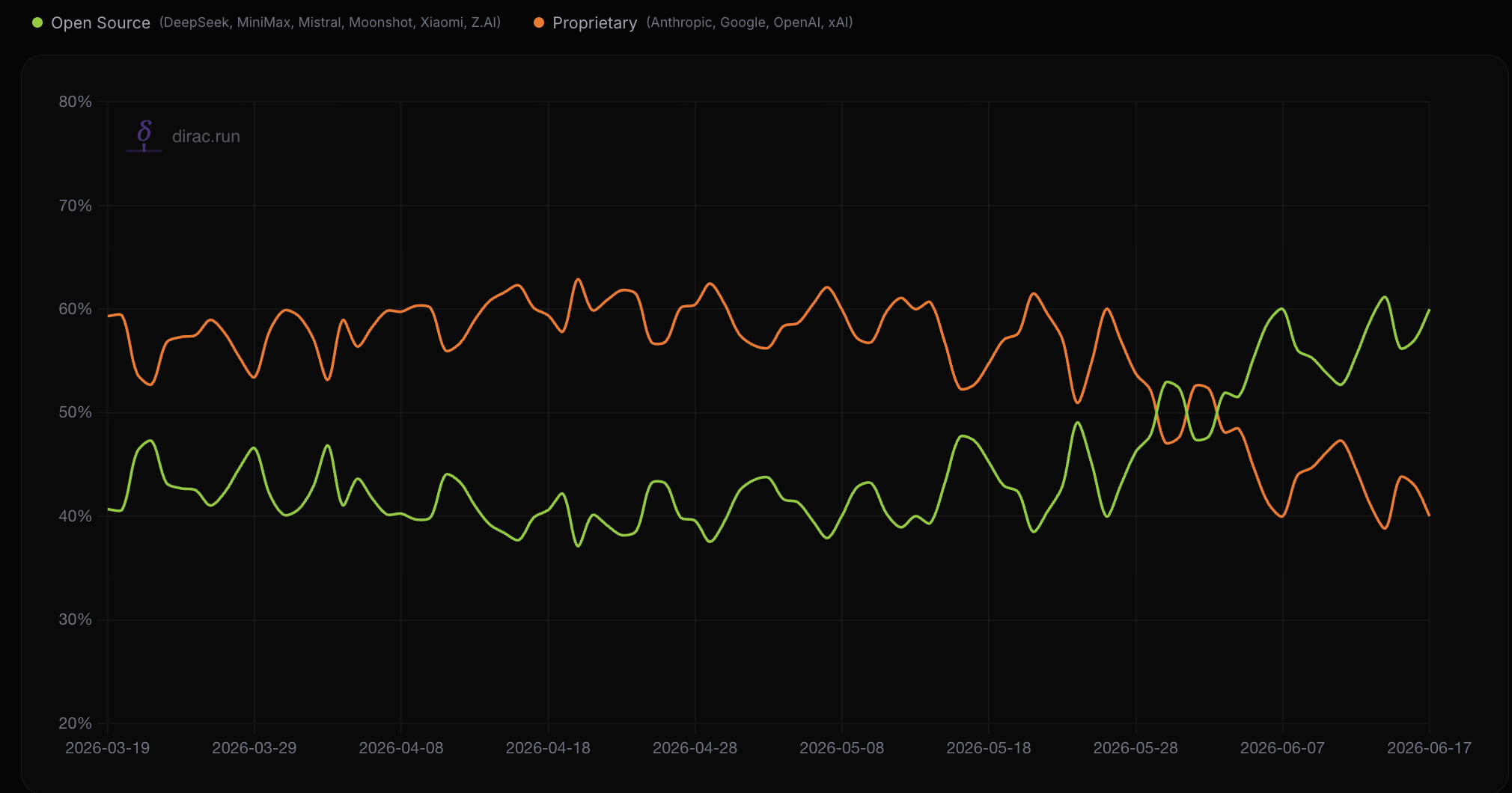
In conclusion, the Dirac Labs data documenting the overwhelming share of open-weights models in OpenRouter traffic provides empirical evidence of a structural transition in how artificial intelligence is consumed at scale. While the dataset is constrained by its reliance on a single routing platform and its measurement of token volume rather than holistic market value, it signals that the technical and economic advantages of open-weights models are driving widespread adoption. For the field of educational technology, this trend lowers the barriers to deploying sophisticated AI systems, enables greater institutional control over learning environments, and opens pathways for deeper technical engagement within academic curricula. As inference traffic continues to concentrate around openly distributed models, the design of AI-mediated learning experiences will increasingly depend on the capabilities and constraints of these accessible architectures rather than the closed ecosystems of proprietary providers.