
Field notes · October 16, 2026
On-Device Agentic AI and Educational Data Privacy
A solo developer has released SteerClaw Mobile, an application that executes a complete agentic loop on consumer smartphones using local large language models. This development raises significant questions regarding data privacy, computatio
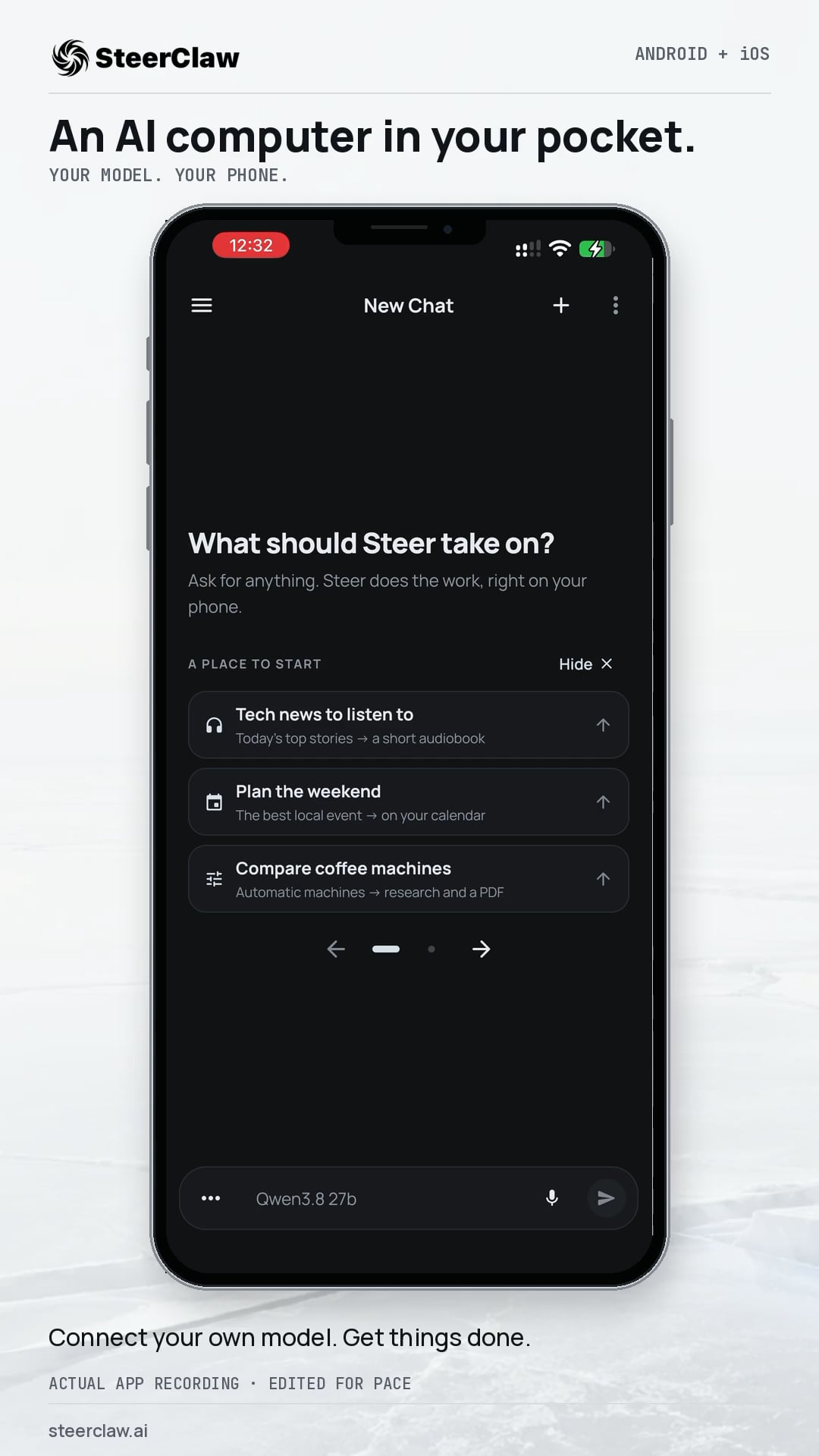
A recent post on the r/LocalLLaMA community forum details the release of SteerClaw Mobile, an application developed by a solo engineer to execute a complete agentic artificial intelligence loop directly on consumer smartphones. The developer states that the project originated from their experience running the Qwen 3.8 model on an NVIDIA RTX 4090 desktop graphics processing unit, which prompted an interest in replicating similar capabilities on mobile hardware. According to the source, SteerClaw Mobile allows users to connect a local large language model, Model Context Protocol (MCP) servers, and external search providers directly through the device. The developer emphasizes that the architecture is designed to be fully private, asserting that all user data remains on the phone and all large language model processing occurs locally rather than being transmitted to remote cloud servers. The application is currently distributed via an Apple TestFlight link, indicating it is in a beta testing phase for iOS devices. The post generated eighteen comments within the community, reflecting active interest in the intersection of mobile hardware and local agentic workflows.
The theoretical significance of this development lies in its architectural departure from the prevailing paradigm of educational artificial intelligence, which predominantly relies on centralized cloud computing. By executing the entire agent loop—encompassing reasoning, tool invocation via MCP servers, and information retrieval through search providers—on the device itself, SteerClaw Mobile represents a shift toward edge computing in agentic systems. The mechanism relies on the increasing computational capacity of modern smartphone neural engines and the availability of highly optimized, smaller-scale language models capable of running within the thermal and memory constraints of mobile hardware. The integration of MCP servers suggests that the agent can interact with structured tools and local files, while the inclusion of search providers indicates a hybrid approach where local reasoning is augmented by external, potentially networked, information retrieval without necessarily exposing the core conversational context to a third-party language model provider.
However, the evidence provided in the source material presents several limitations that must be acknowledged before extrapolating to broader educational contexts. First, the report originates from a self-published forum post by a solo developer rather than a peer-reviewed technical paper or an independent benchmark study. Consequently, there are no empirical metrics provided regarding inference latency, token generation speed, battery consumption, or thermal throttling during sustained agentic loops on mobile hardware. Second, while the developer references prior experience with Qwen 3.8 on a high-end desktop GPU, the specific model utilized in the mobile application is not identified. The performance gap between a desktop RTX 4090 and a mobile system-on-a-chip is substantial, meaning the complexity of tasks the mobile agent can handle is likely severely constrained compared to its desktop inspiration. Third, the claim of total privacy requires scrutiny; while the language model processing may occur locally, the connection to external search providers inherently involves transmitting queries over a network, which introduces potential privacy vectors depending on how those queries are formulated and routed.
Despite these evidentiary limits, the implications for teaching and learning with artificial intelligence are conceptually significant if the underlying technical claims hold true under rigorous evaluation. In educational environments, particularly at the primary and secondary levels, student data privacy is governed by stringent regulatory frameworks such as the Family Educational Rights and Privacy Act (FERPA) in the United States and the General Data Protection Regulation (GDPR) in Europe. Cloud-based AI tools frequently present compliance challenges because student interactions, prompts, and generated outputs are processed on external servers, creating persistent data trails. An agentic system that processes all language model computations locally on a student's device theoretically eliminates the risk of unauthorized data harvesting by third-party AI providers. This localized architecture could enable schools to deploy sophisticated AI agents for personalized tutoring, research assistance, or administrative automation without violating institutional data governance policies.
Furthermore, the integration of MCP servers into a local mobile agent introduces a framework for what might be termed situated agentic learning. Because MCP allows standardized connections to various tools and data sources, an educational version of such an application could securely interface with a school's local learning management system, digital library, or proprietary datasets without routing that sensitive information through a commercial cloud API. The agent could autonomously plan and execute multi-step research tasks, utilizing local documents as its primary knowledge base while selectively querying external search providers for supplementary information. This transforms the smartphone from a passive content consumption device into an active, private computational partner.
Nevertheless, the practical deployment of such technology in education faces structural barriers. The requirement for students to possess sufficiently powerful smartphones introduces a digital equity concern, as older or budget devices may lack the memory or processing power required to run local language models effectively. Additionally, the pedagogical design of curricula would need to account for the unique failure modes of small, locally running models, which are more prone to hallucination and logical errors than massive frontier models hosted in the cloud. Educators would need to develop assessment strategies that evaluate the student's ability to direct and verify the local agent's output, rather than relying on the agent's inherent accuracy. Ultimately, SteerClaw Mobile illustrates a viable architectural pathway for private, on-device AI agents, suggesting that the future of educational AI may not exclusively depend on continuous connectivity to centralized corporate infrastructure, but rather on the intelligent orchestration of local computational resources.
Source: Claude CoWork for Local LLMs that runs on your Phone