
Trends · October 28, 2026
moe kindergarten full day programme 2028 and AI Agents
As Singapore scales the moe kindergarten full day programme 2028, teaching agents can support early childhood educators with personalized learning tasks.
In Singapore, early childhood education is undergoing a structural shift that will redefine how young children spend their days. The recent surge in search interest around the moe kindergarten full day programme 2028 reflects widespread attention to the Ministry of Education’s plan to progressively offer full-day programs across all its kindergartens. According to Channel News Asia, this expansion aims to provide more comprehensive care and learning opportunities for preschool-aged children starting from that year. For teachers and researchers examining the intersection of pedagogy and technology, this policy change presents a distinct challenge: how to sustain high-quality, developmentally appropriate instruction over a significantly longer school day without overwhelming early childhood educators. One emerging answer lies in the deployment of teaching agents designed to handle personalized learning activities and administrative automation.
The transition from half-day to full-day kindergarten is not merely an extension of hours; it requires a fundamental rethinking of curriculum pacing, rest periods, and individualized engagement. Mothership reports that the Ministry of Education intends to pilot the full-day model at two kindergartens in 2027 before rolling it out to all MOE kindergartens by 2030. This phased approach provides a critical window for educational technologists and school leaders to test supportive tools. The official MOE Kindergarten Programme page details the broader goals of these institutions, emphasizing holistic development and foundational skills. When those foundational hours double, the cognitive load on teachers increases proportionally. Educators must track more developmental milestones, manage longer behavioral arcs, and maintain individualized attention for larger cohorts of children spending six or more hours in the classroom. Teaching agents—software systems capable of executing specific instructional or organizational tasks autonomously—offer a mechanism to distribute this increased burden.
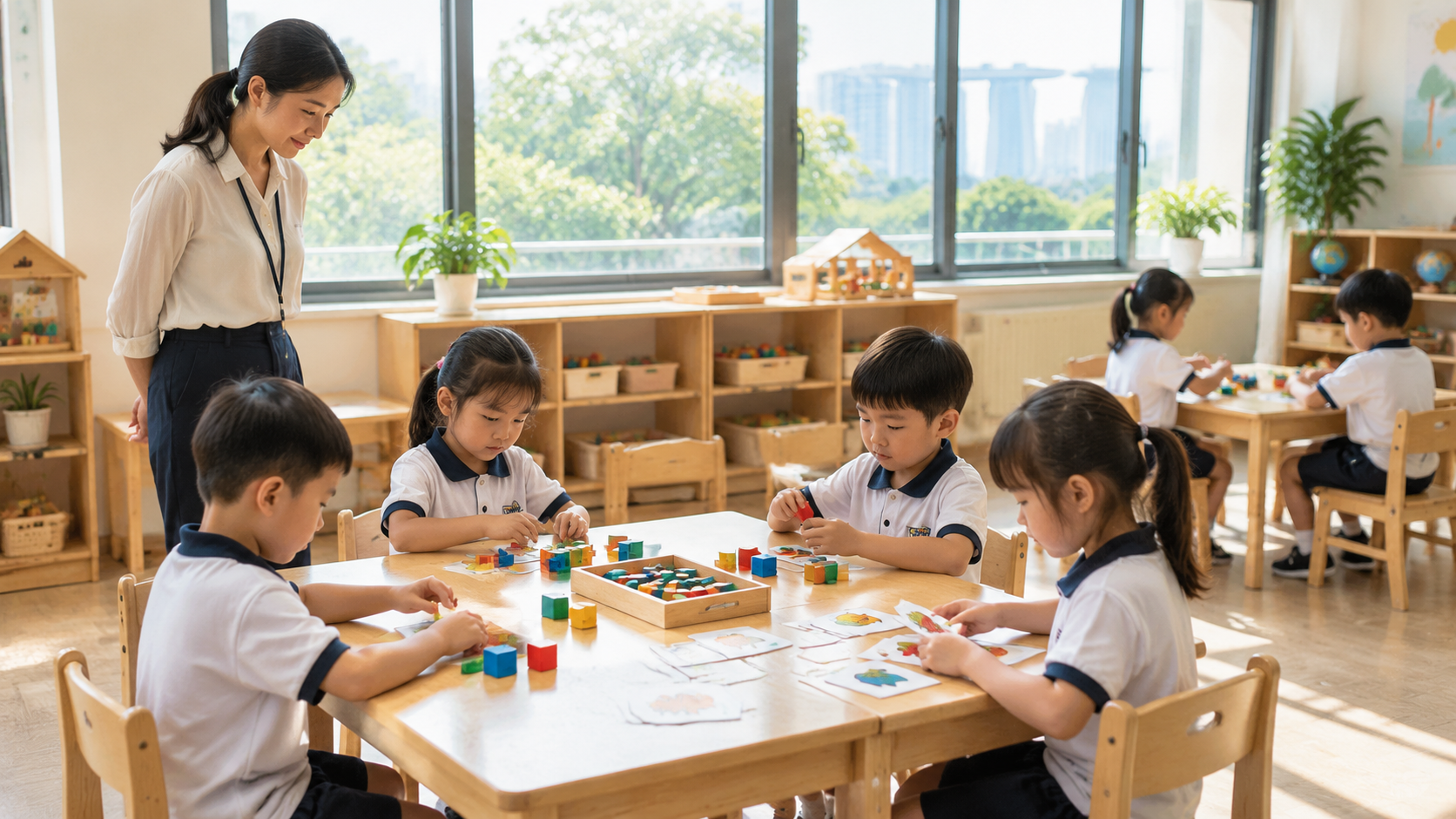
Operational Demands of the moe kindergarten full day programme 2028
A longer school day introduces complex logistical and pedagogical demands. Teachers must seamlessly transition children between structured learning, free play, meals, and rest. In a half-day program, the intensity of direct instruction is concentrated; in a full-day setting, pacing becomes paramount to prevent fatigue in both students and staff. The reporting from The Straits Times highlights that the rollout of full-day care by 2030 is a major infrastructural undertaking, requiring adjustments in staffing and daily scheduling.
Teaching agents can address these operational demands through administrative automation. Rather than replacing the human educator, these agents function as background infrastructure. They can automate attendance tracking, generate daily communication logs for parents, and organize digital portfolios of student work. By removing these repetitive clerical tasks from the teacher’s workflow, educators reclaim time that can be redirected toward meaningful interpersonal interactions, which remain the cornerstone of early childhood development. Furthermore, automated scheduling assistants can help teachers dynamically adjust the day's flow based on real-time observations of student energy levels, ensuring that rigorous cognitive tasks are balanced with necessary physical movement and rest.

Personalized Learning Through Teaching Agents
Beyond administrative relief, the most significant opportunity presented by the moe kindergarten full day programme 2028 is the potential for deeper personalization. Young children develop literacy, numeracy, and socio-emotional skills at vastly different rates. A full-day schedule theoretically allows more time for individualized interventions, but only if teachers have the tools to identify and act upon each child's specific needs efficiently.
Singapore’s EdTech Masterplan 2030 outlines a national vision for technology-enhanced learning, explicitly advocating for AI-driven personalized learning pathways. While much of the masterplan focuses on primary and secondary education, its underlying principles apply directly to the preschool sector. Teaching agents aligned with this framework can analyze formative assessment data gathered during morning activities to suggest targeted, play-based interventions for the afternoon session. For instance, if an agent identifies that a small group of children is struggling with phonemic awareness during a morning storytelling block, it can prompt the teacher with specific, game-like activities tailored to those learners for the post-lunch period.
These agents do not deliver screen-based instruction to four- and five-year-olds, which would contradict established early childhood pedagogical norms. Instead, they act as decision-support systems for the human teacher. They curate resources, sequence activities, and flag developmental concerns early. Researchers exploring frameworks like the Classroom Observatory can study how these agent-mediated environments alter teacher-student interaction patterns over extended school days. The goal is to ensure that the additional hours provided by the full-day program translate into richer, more responsive learning experiences rather than mere custodial care.
Preparing Educators for Agent-Assisted Classrooms
The successful integration of teaching agents into the expanded kindergarten landscape depends entirely on educator readiness. The pilot phases mentioned by Mothership and The Straits Times serve as essential testing grounds not just for the physical logistics of full-day care, but for the technological workflows that will support it. Teachers require professional development that moves beyond basic digital literacy toward an understanding of how to collaborate with autonomous software agents.
Educators must learn to interpret the recommendations generated by these systems, override them when contextual knowledge dictates, and provide feedback that refines the agent's future suggestions. The institutional framework provided by the EdTech Masterplan 2030 supports this by emphasizing the role of teachers as designers of learning experiences, augmented rather than replaced by technology. As the search interest surrounding the moe kindergarten full day programme 2028 demonstrates, public and professional anticipation is already building. Channel News Asia notes the progressive nature of this rollout, signaling that schools have time to adapt.
Ultimately, the expansion of full-day kindergarten in Singapore represents a systemic stress test for early childhood education. It asks whether schools can provide more hours of care while simultaneously elevating the quality of that care. Teaching agents, grounded in national policy frameworks and designed specifically for the developmental realities of young children, offer a viable path forward. By automating the administrative overhead and surfacing actionable insights for personalized learning, these tools can help ensure that the extended school day benefits both the developing child and the dedicated educator guiding them.
Sources
- All MOE kindergartens to progressively offer full-day programme from 2028
- All MOE kindergartens rolling out full-day care by 2030, to be piloted at 2 branches in 2027
- MOE to pilot full-day model at 2 kindergartens in 2027, roll out to all MOE kindergartens by 2030
- MOE Kindergarten (MK) Programme
- EdTech Masterplan 2030