
Field notes · October 17, 2026
Longitudinal Tracking of Model Drift via LiveNerf
The LiveNerf project tracks daily performance variations in Anthropic's Opus 5.5 model to test community claims of post-release degradation, yielding unexpected results over a three-week observation period.
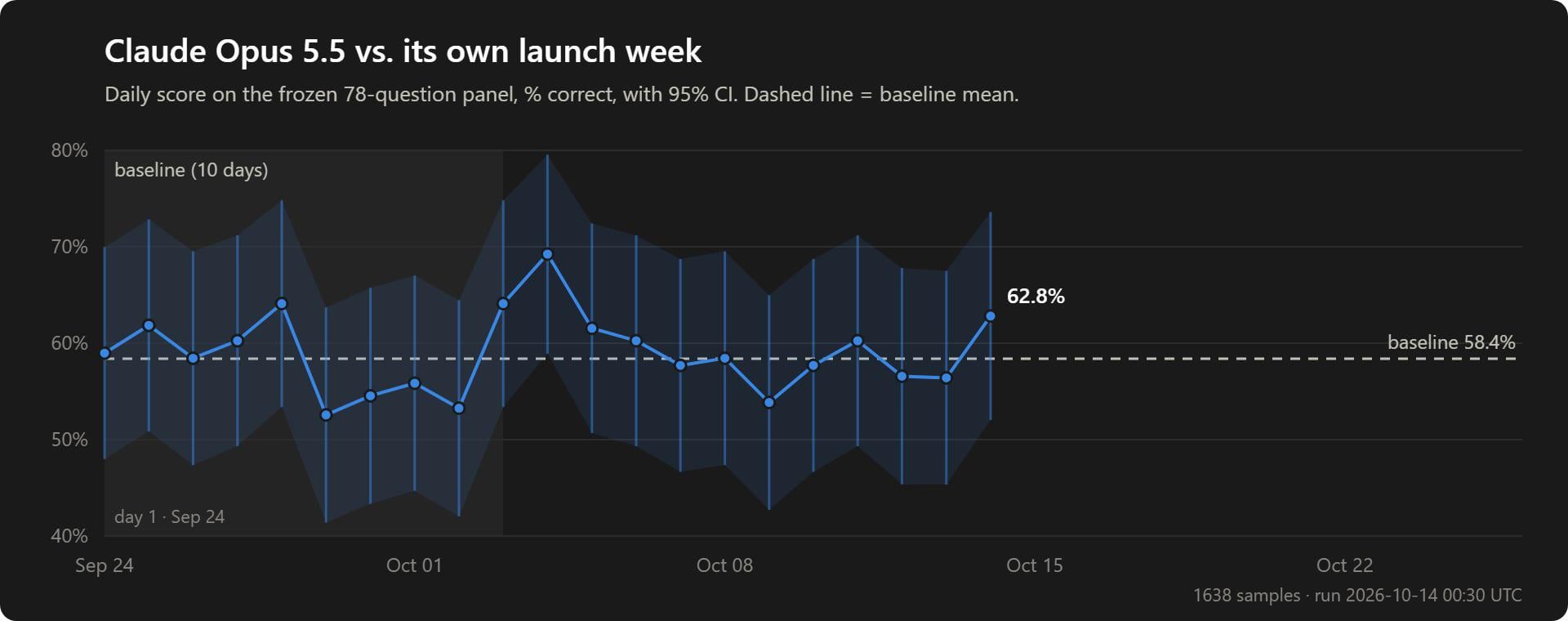
A recent update from the LiveNerf project, documented on the r/ClaudeAI forum and maintained via a public GitHub repository by user ninjahawk, reports on a three-week longitudinal effort to measure the capability of Anthropic’s Opus 5.5 model over time. The stated objective of the project was to determine, using an unbiased set of data, whether Anthropic systematically degrades or 'nerfs' its models after their initial release. The author notes that measurements have been conducted daily since the project's inception. According to the update, the observed results have not aligned with the expectations of the broader user community, which had largely anticipated finding evidence of deliberate performance reduction. The author directs interested parties to the associated GitHub repository for continued tracking of Opus 5.5 performance metrics.
The phenomenon under investigation by LiveNerf is commonly referred to in machine learning operations as model drift or temporal degradation. In traditional predictive machine learning, drift occurs when the statistical properties of the target variable change over time, or when the relationship between input features and the target variable shifts due to changes in the underlying environment. However, large language models (LLMs) like Opus 5.5 are generative systems rather than purely predictive classifiers deployed on streaming tabular data. For an LLM accessed via an application programming interface (API), apparent performance changes can stem from several distinct mechanisms that do not necessarily involve the intentional degradation of the base model weights.
One primary mechanism for observed variation is backend infrastructure optimization. Providers frequently adjust inference parameters—such as temperature defaults, top-p sampling thresholds, or system prompt injections—to manage computational costs, ensure safety compliance, or balance server loads across global regions. These adjustments can alter the stylistic or structural output of a model without changing its fundamental reasoning capabilities. Another mechanism involves silent versioning, where a provider updates a model endpoint labeled with a specific name (e.g., 'Opus 5.5') to a slightly revised checkpoint that addresses critical bugs or safety vulnerabilities. Users interacting with the API may perceive these revisions as a sudden shift in capability, interpreting a change in behavior as a loss of competence.
The evidentiary limits of community-driven benchmarking projects like LiveNerf must be carefully considered. The author asserts the use of an 'unbiased set of data,' yet constructing a truly unbiased evaluation suite for a general-purpose LLM is methodologically fraught. If the daily prompts rely on static benchmarks, the model's outputs may vary due to the inherent stochasticity of autoregressive generation rather than systemic degradation. Conversely, if the prompts are dynamic, isolating the variable of model capability from the variable of prompt difficulty becomes highly complex. Furthermore, without access to Anthropic’s internal deployment logs, routing configurations, or exact inference parameters at the time of each query, external observers cannot definitively distinguish between a change in the model's weights and a change in the serving infrastructure. The observation that results 'haven’t necessarily been what the community expected' suggests that the hypothesis of deliberate nerfing may be driven more by user perception and confirmation bias than by empirical reality, though the precise nature of the unexpected results remains unspecified in the brief update.
When the link between model instability and educational technology is examined, the implications for teaching and learning with AI become significant. Educational institutions increasingly integrate commercial LLMs into instructional workflows, relying on API endpoints to power automated grading, personalized tutoring, and content generation. If a model's behavior fluctuates daily due to undocumented backend adjustments, the reliability of these educational tools is compromised. A lesson plan generated by an AI tutor on Monday may differ substantially in pedagogical tone, factual density, or structural formatting from one generated on Friday, even if the underlying prompt remains identical. This inconsistency introduces friction into curriculum design, as educators cannot guarantee uniform student experiences across different cohorts or time periods.
Moreover, the opacity of model updates poses challenges for institutional assessment and accountability. When an AI tool used for formative assessment suddenly alters its evaluation criteria due to a silent backend update, the validity of the resulting student data is threatened. Educators may misinterpret a drop in student performance as a learning deficit, when it is actually an artifact of shifted model behavior. The LiveNerf project highlights the necessity for educational technologists to implement continuous, localized monitoring of AI tools rather than assuming static performance post-deployment.
From a theoretical standpoint, this issue intersects with the concept of technological determinism and the alignment of artificial agents with human pedagogical intent. When educators deploy AI, they implicitly construct a mental model of the tool's capabilities and boundaries. Temporal drift disrupts this mental model. If the AI's responses become unpredictable, the educator's ability to orchestrate learning activities diminishes. The reliance on proprietary, closed-source models means that educational practitioners are subject to the operational decisions of the AI company, including cost-saving measures or safety patches that may inadvertently alter educational utility.
Ultimately, the LiveNerf initiative represents a valuable empirical effort to demystify the lifecycle of commercial AI models. While the current findings challenge the community's assumption of deliberate nerfing, the broader lesson for educational AI integration is clear: treating an API endpoint as a stable, unchanging instrument is empirically unsound. Institutions utilizing AI for instruction must develop robust evaluation frameworks capable of detecting temporal variance, ensuring that fluctuations in model behavior do not silently undermine pedagogical objectives or compromise the integrity of student assessment.