
Field notes · November 6, 2026
Local Model Resilience When Cloud APIs Disconnect
A community benchmark demonstrates that a local 27-billion-parameter model completed a multi-part coding task after cloud API connections were severed, while a cloud-dependent agent stalled. The result highlights the reliability advantages
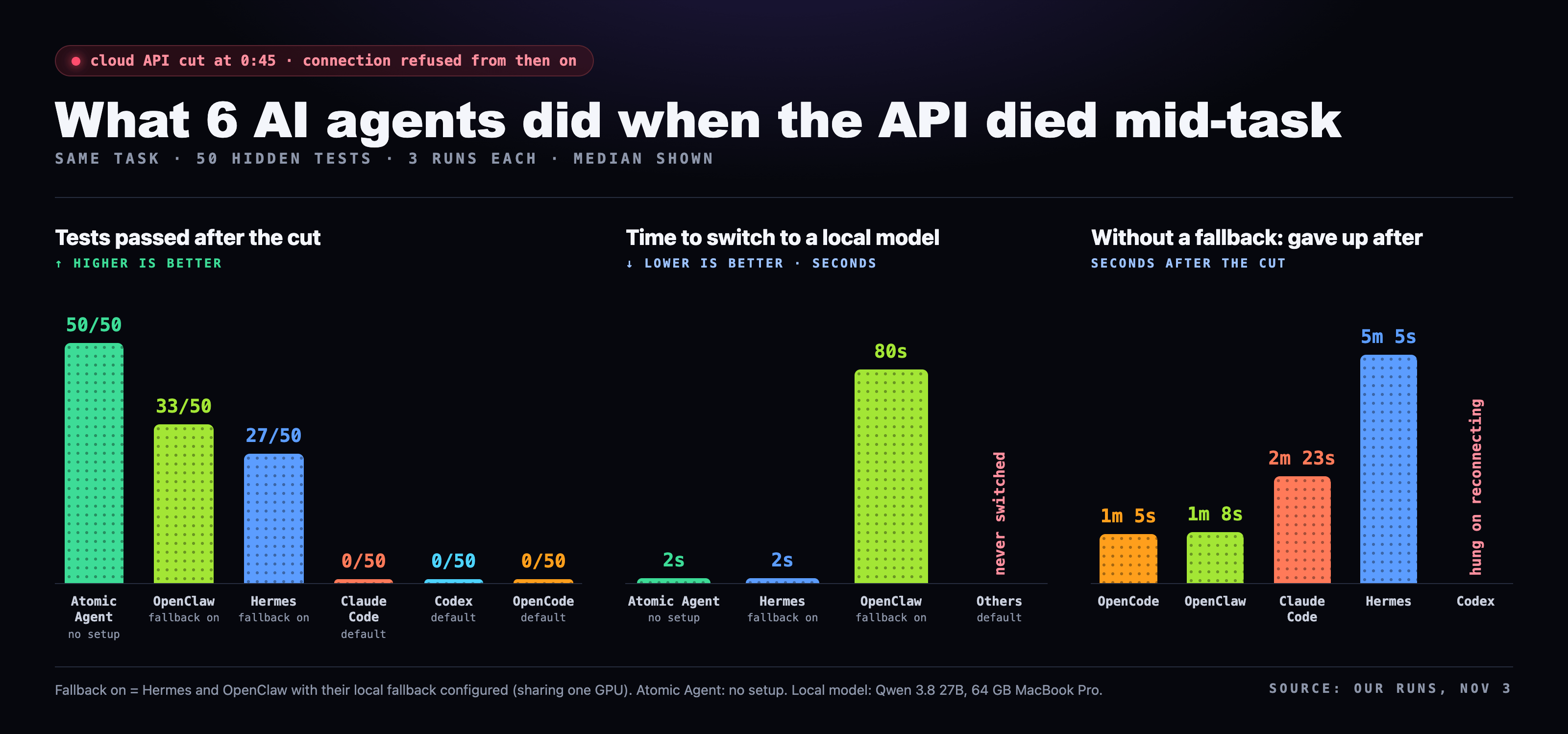
A recent technical report shared on the r/LocalLLaMA forum details a comparative evaluation of local and cloud-based artificial intelligence agents under conditions of network failure. The author describes an experimental setup in which two distinct coding agents were tasked with generating a five-part Python application evaluated against fifty hidden tests. One agent relied on a locally hosted Qwen 3.8 27B model (quantized to Q4 and run via llama.cpp with two slots) operating on a 64 GB MacBook Pro. The other agent depended on cloud infrastructure, specifically routing requests to GPT-6.1 Terra through OpenRouter, with Haiku 5.5 utilized for Claude Code due to its restriction to Anthropic models. The critical intervention occurred at forty-five seconds into the execution, when a proxy was configured to refuse every subsequent cloud connection, effectively severing the remote agent’s access to its underlying model. Each agent was given three runs with a twenty-minute time cap. According to the author’s reported results, the local Qwen 27B model successfully finished the task in all three out of three runs following the network cut. In contrast, the cloud-dependent Codex agent failed to complete the work, stalling indefinitely on a “Reconnecting...” status message. The post includes eight comments from the community discussing the implications of this divergence.
The theoretical mechanism underlying this result is architectural resilience in distributed versus localized inference systems. Cloud-dependent AI agents operate on a client-server paradigm where the local environment handles orchestration, file system access, and tool execution, but relies entirely on a remote server for the computationally expensive process of token generation. When the network connection is interrupted, the feedback loop between the agent’s planning module and the language model’s reasoning engine is broken. The agent enters a suspended state, waiting for an acknowledgment or payload that will never arrive, as observed in the persistent “Reconnecting...” prompt. Conversely, a local model running via an inference engine like llama.cpp processes all computations on the host machine’s hardware. The API endpoint (noted in the source as http://127.0.0.1:8080/v1) resolves internally, meaning the agent’s orchestration loop remains unbroken regardless of external network conditions. The continuity of the inference pipeline allows the local agent to maintain its context window, execute sequential tool calls, and iterate through the programming task without interruption.
However, the limits of this evidence must be carefully delineated before drawing broad conclusions about model capability. First, the data originates from a single user’s informal benchmark posted to a community forum rather than a peer-reviewed methodology. The sample size consists of three runs per agent, which is insufficient for statistical significance. Second, the comparison conflates two distinct variables: the hosting environment (local versus cloud) and the specific model architectures (Qwen 3.8 27B versus GPT-6.1 Terra and Haiku 5.5). It is impossible to determine from this report whether the cloud agent’s failure was purely a function of network dependency or if differences in the models’ inherent coding capabilities also played a role. Third, the hardware requirements for the successful local run—a 64 GB MacBook Pro—are substantial. The Q4 quantization reduces memory overhead, but running a 27-billion-parameter model still demands significant unified memory and compute resources, which introduces a barrier to entry that cloud APIs inherently bypass. Finally, the task itself, while complex enough to require fifty hidden tests, represents a specific type of deterministic software engineering problem; it remains unclear whether local models would exhibit similar uninterrupted success in highly ambiguous or creatively open-ended tasks.
When the link between infrastructure reliability and educational outcomes is examined, these findings carry meaningful implications for teaching and learning with AI. In educational settings where students use AI coding assistants to learn programming, develop projects, or complete assessments, workflow interruptions can severely disrupt the learning process. If a student is engaged in a complex debugging session or iteratively building an application with an AI tutor, a sudden loss of cloud connectivity halts the interaction. This interruption not only wastes instructional time but can also fracture the student’s focus and momentum, forcing them to abandon the cognitive thread they were developing. The demonstration that a local model can seamlessly continue executing a multi-step task despite network failures suggests that local inference could provide a more stable environment for sustained, deep engagement with AI tools.
Furthermore, reliance on cloud APIs introduces issues of equity and access in educational contexts. Students in rural areas, those using institutional networks with strict firewall policies, or learners in regions with unstable internet infrastructure are disproportionately affected by cloud dependency. A shift toward capable local models, provided the hardware constraints can be mitigated through institutional investment or further optimization, could democratize access to uninterrupted AI assistance. Educators designing curricula that integrate AI agents must consider the fragility of cloud dependencies. If an assessment requires continuous interaction with an AI system, a network outage could unfairly penalize students relying on remote models. Integrating local inference options ensures that the pedagogical focus remains on the learning objectives—such as algorithmic thinking, code structure, and problem decomposition—rather than being derailed by infrastructural vulnerabilities. Ultimately, this community experiment underscores that the physical location of the model’s weights is not merely a technical detail, but a foundational factor in the reliability and equity of AI-mediated education.