
Field notes · October 8, 2026
Local AI Storage Overhead and the Hidden Infrastructure of Learning
A developer report on local AI storage consumption reveals that standard tools accumulate tens of gigabytes of redundant data, raising questions about the material infrastructure required for educational AI use.
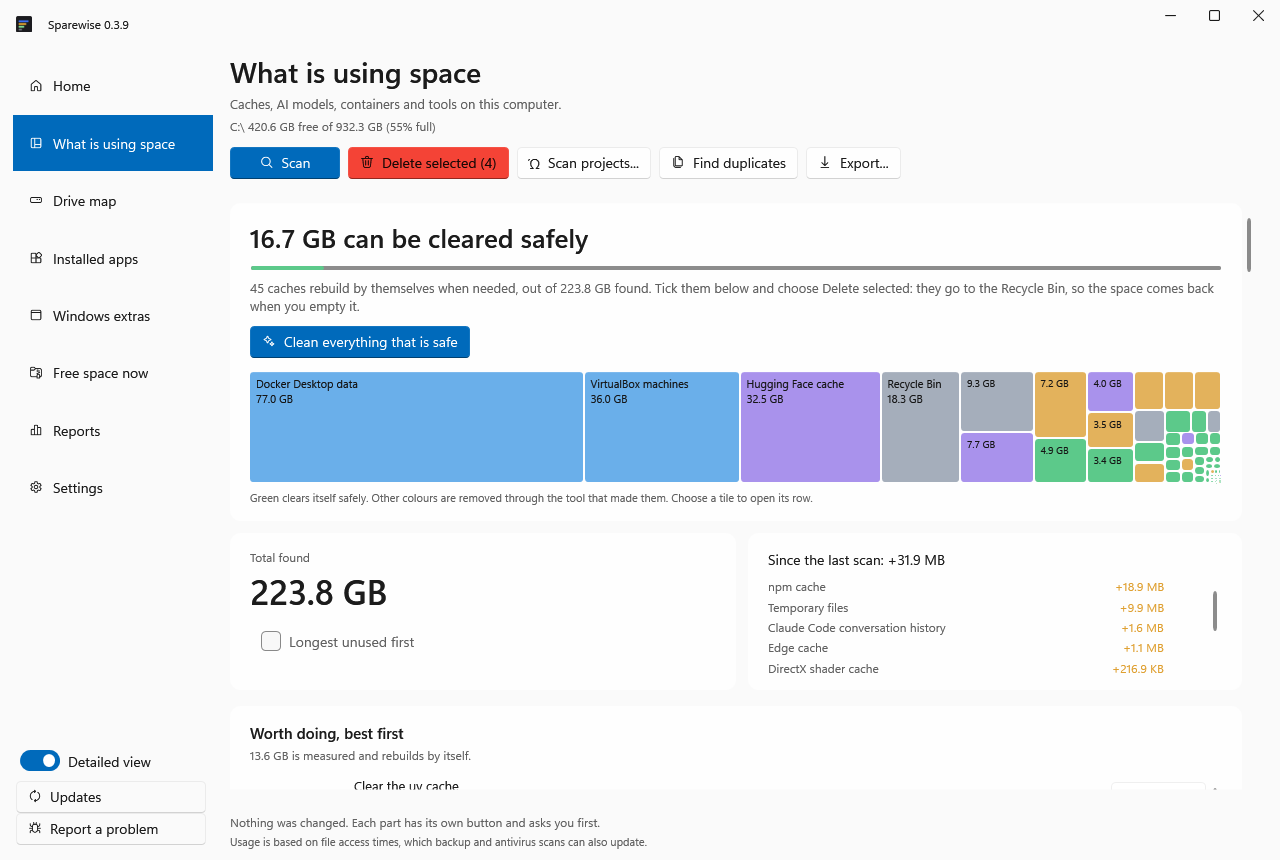
A recent post on the r/LocalLLaMA community forum documents a practical investigation into the storage overhead generated by locally installed artificial intelligence tools. The author reports that their laptop’s C: drive was being consumed by 44 gigabytes of data associated with AI development and usage. Upon inspection, this footprint was attributed to three primary sources: Hugging Face model files, which accounted for 32.5 gigabytes and included outdated versions of models that had already been updated; virtual machine bundles associated with Claude, totaling 7.7 gigabytes; and pip and uv package manager caches, which occupied 8.3 gigabytes. In response to this accumulation, the author developed Sparewise, a free Windows application designed to audit local AI storage. According to the author, the tool lists every local model alongside its file size and last date of use. Crucially, the application is designed never to delete model files autonomously; instead, it targets caches that can be safely rebuilt by the system, and it includes an undo function for all clearing operations. The author further notes that the tool requires no user account and performs no telemetry. The post has generated discussion within the community, as indicated by twelve comments, and the tool is hosted at sparewise.app.
While this report originates from a practitioner rather than a peer-reviewed academic study, it provides empirical observation regarding the material realities of running artificial intelligence locally. The theoretical implications of these observations are significant for the field of educational technology, particularly as institutions and independent learners increasingly explore local AI deployment to address privacy, cost, or connectivity concerns.
The mechanism driving this storage bloat is rooted in the architecture of modern machine learning workflows. Large language models and other neural networks are distributed as massive parameter files, often several gigabytes each. Platforms like Hugging Face facilitate easy downloading of these models, but their default caching mechanisms frequently retain older versions even after a user updates to a newer iteration. This redundancy occurs because the package managers and version control systems prioritize availability and rollback capabilities over disk space conservation. Similarly, Python environment managers such as pip and uv store downloaded packages and compiled wheels in local caches to accelerate future installations. When developers or students experiment with multiple AI libraries, these caches grow rapidly. The 7.7 gigabytes consumed by Claude’s virtual machine bundles suggest that certain AI applications require isolated runtime environments, further compounding the storage demand. Together, these mechanisms create a hidden layer of digital infrastructure that operates silently in the background, consuming hardware resources without explicit user intervention.
The limits of the evidence presented in this source must be acknowledged. The data reflects a single user’s experience on a specific operating system (Windows) and is self-reported via a community forum rather than a controlled scientific methodology. The exact configuration of the user’s workflow, the frequency of their model updates, and the specific AI tools they employed are not exhaustively detailed. Consequently, the 44-gigabyte figure cannot be generalized as a universal baseline for all local AI users. Furthermore, the proposed solution, Sparewise, is a newly developed, third-party utility that has not yet undergone formal security auditing or widespread institutional adoption. Its efficacy and safety, while logically sound based on the author's description of targeting only rebuildable caches, remain empirically unverified at scale. Nevertheless, the underlying phenomenon—the rapid and opaque accumulation of storage by AI tools—is consistent with broader technical knowledge regarding machine learning infrastructure.
When linking these infrastructural realities to teaching and learning with AI, several critical implications emerge. First, the assumption that local AI deployment inherently solves accessibility issues is challenged by the hardware requirements revealed in this report. If a student or educator attempts to run local models on a standard-issue school laptop or a personal device with limited storage, the 44-gigabyte overhead described here could render the machine unusable for other tasks. Educational institutions advocating for local AI use to protect student data privacy must therefore account for the material prerequisites of such a policy. Providing software access without ensuring adequate hardware capacity creates a new vector for digital inequity.
Second, the opacity of cache accumulation highlights a gap in current AI literacy curricula. Students learning to interact with AI are frequently taught prompt engineering, ethical considerations, and output evaluation, but rarely instructed in the computational hygiene required to maintain their working environments. The retention of obsolete Hugging Face models or bloated pip caches represents a form of technical debt that learners may not understand how to identify or resolve. Integrating basic systems administration and resource management into AI education would empower students to sustain their own practice without relying on external utilities or experiencing sudden hardware failures.
Finally, the design philosophy of the Sparewise tool itself offers a pedagogical model for educational technology. By choosing to list models and clear only rebuildable caches—while explicitly refusing to delete core model files and providing an undo function—the tool embodies a principle of reversible, transparent intervention. In educational settings, AI tools should ideally operate with similar transparency, allowing learners to see what resources are being consumed and providing safe, reversible mechanisms for managing them. The absence of telemetry and account requirements further aligns with the privacy-preserving goals that often motivate local AI adoption in schools. Ultimately, this practitioner report serves as a reminder that artificial intelligence is not merely an abstract cognitive service; it is a physical process that demands substantial material resources, a reality that educators and instructional designers must integrate into their frameworks for AI-assisted learning.