
Field notes · November 12, 2026
Latent-Agent Swarms for Mathematical Discovery
A recent preprint introduces latent-agent swarms as a computationally efficient alternative to evolutionary LLM systems like AlphaEvolve, aiming to accelerate automated mathematical discovery and program optimization.
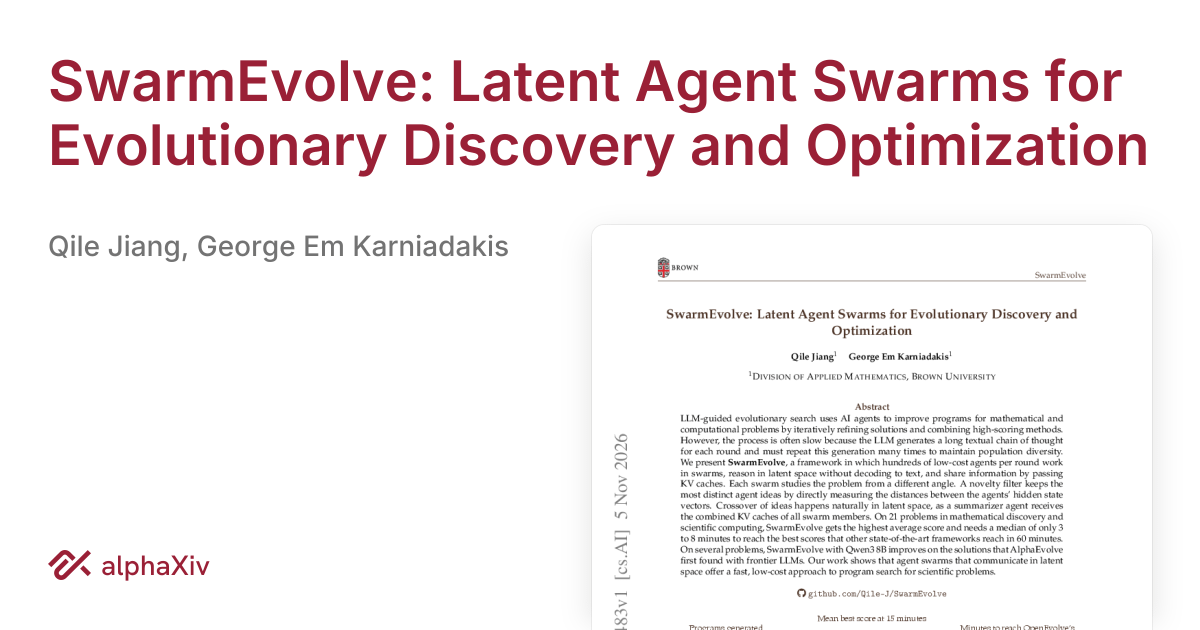
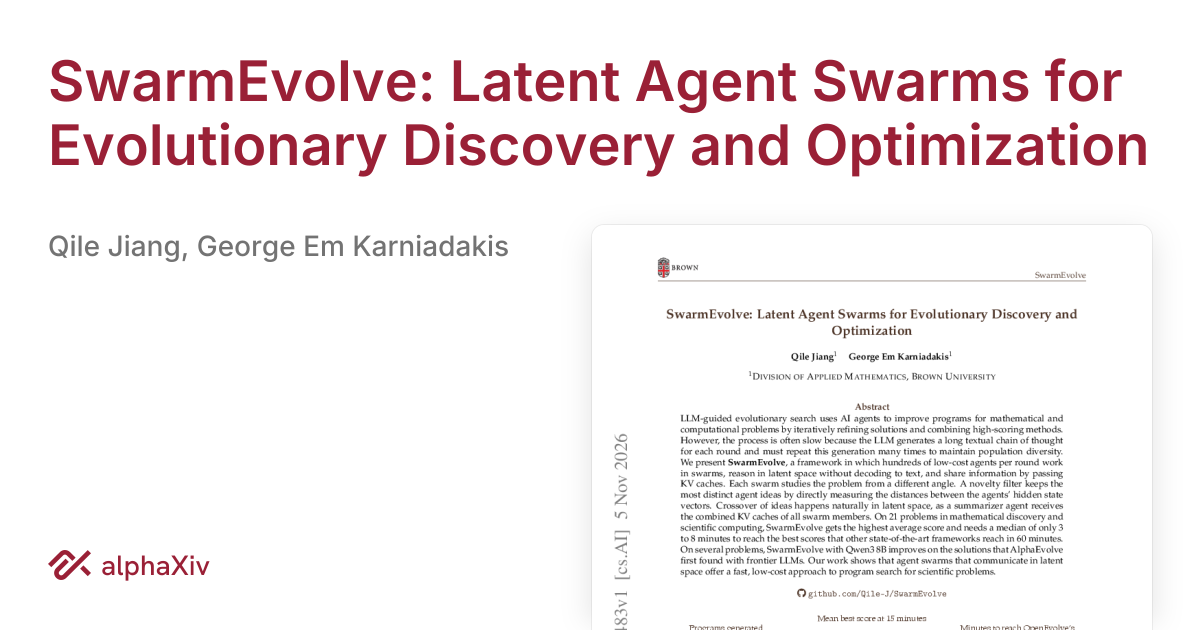
A recent preprint posted to the alphaXiv repository examines the use of latent-agent swarms for mathematical discovery and optimization. The authors situate their work in the context of Google DeepMind’s AlphaEvolve system, which last year identified a faster algorithm for multiplying 4x4 complex matrices, surpassing a computational record that had remained unbroken since 1969. According to the source, AlphaEvolve operates by directing a large language model to write a computer program, scoring the output against a defined objective, and iteratively improving the code through an evolutionary loop. Because this methodology relies on Gemini models and requires extensive iterative evaluation, the authors note that AlphaEvolve and similar open-source implementations tend to be both slow and expensive to execute. The preprint proposes latent-agent swarms as an architectural intervention designed to make this process of automated mathematical discovery faster and cheaper, though the provided excerpt truncates before detailing the specific mechanisms or empirical results of the swarm approach.
The theoretical mechanism underlying systems like AlphaEvolve rests on treating program synthesis as an optimization problem navigated by evolutionary search. In this paradigm, the large language model functions as a mutation operator, generating variations of existing code or proposing novel algorithmic structures. A separate scoring function acts as the fitness evaluator, determining whether a generated program successfully solves the target mathematical problem or improves upon a known baseline. By iterating this generate-and-score loop, the system explores a vast space of potential algorithms without requiring human intuition at every step. The shift toward latent-agent swarms, as proposed in the cited preprint, suggests a move away from monolithic, single-model evolutionary loops toward distributed, parallelized search strategies. In swarm intelligence, multiple agents operate concurrently, sharing information about promising regions of the search space. If these agents operate in a latent space—manipulating compressed representations of programs or mathematical concepts rather than raw text tokens—the computational overhead associated with repeatedly prompting and decoding from a massive language model could be substantially reduced. This would theoretically allow for broader exploration of algorithmic possibilities within constrained compute budgets.
However, the limits of the evidence presented in the available notes must be carefully acknowledged. The source material is a brief summary of a preprint, lacking detailed methodology, experimental design, or quantitative results. It is unknown whether the latent-agent swarm successfully matched the performance of AlphaEvolve on standard benchmarks, nor is it clear how the authors define and measure improvements in speed and cost. Furthermore, the 1969 matrix multiplication record broken by AlphaEvolve represents a highly specific, narrow mathematical achievement. Extrapolating from this success to general mathematical discovery or broader educational applications requires caution. Evolutionary program synthesis excels in domains where fitness can be rigorously and automatically computed, such as algorithmic efficiency or formal proofs. It is less clear how such systems perform when the objective function is ambiguous, subjective, or deeply contextual, which is frequently the case in real-world problem-solving.
Despite these evidentiary constraints, the conceptual architecture of evolutionary AI systems and latent-agent swarms carries significant implications for teaching and learning with artificial intelligence, provided the link between automated discovery and pedagogy is grounded in realistic classroom dynamics. When AI systems are capable of autonomously discovering novel algorithms or optimizing mathematical procedures, the nature of mathematics education must shift. If an AI can derive a faster method for matrix multiplication, the pedagogical focus may need to transition from rote procedural execution toward higher-order competencies: understanding why certain algorithms are efficient, formulating the correct problem statements for AI solvers, and critically evaluating the outputs generated by automated systems. Students learning linear algebra or computer science in an era of evolutionary AI must be prepared to interact with tools that do not merely retrieve existing knowledge but actively generate new computational methods.
Moreover, the proposed efficiency gains of latent-agent swarms have direct practical implications for educational technology. Current AI-driven tutoring systems that rely on heavy, iterative generation loops are often too costly or latency-prone for widespread deployment in under-resourced schools. If swarm-based architectures can achieve comparable exploratory power at a fraction of the computational cost, it becomes more feasible to deploy dynamic, exploratory AI environments in classrooms. For instance, students could interact with localized AI agents that explore mathematical conjectures alongside them in real time, rather than waiting for cloud-based models to return static answers. This transforms the AI from a mere oracle into a collaborative research partner.
Nevertheless, educators must recognize the epistemological risks inherent in relying on evolutionary AI for mathematical instruction. An AI system that optimizes a program through thousands of iterations may arrive at a correct and efficient solution via pathways that are entirely opaque to human reasoning. If a student uses such a tool to solve a math problem, they may receive the correct answer without gaining any conceptual understanding of the underlying mathematics. Therefore, integrating latent-agent swarms or evolutionary AI into educational settings requires deliberate instructional design that prioritizes interpretability. Teachers would need frameworks to help students unpack the AI’s discoveries, ensuring that the automation of mathematical optimization serves to deepen human comprehension rather than replace it. Ultimately, while the preprint highlights promising directions for reducing the cost and latency of AI-driven discovery, translating these computational advances into meaningful learning experiences remains a complex challenge requiring rigorous pedagogical validation beyond the scope of current machine learning benchmarks.
Source: [Using latent-agent swarms for math discovery and optimization [R]](https://www.alphaxiv.org/abs/2611.08483)