
Field notes · October 28, 2026
Cost and Latency in Frontier-Local Coding Architectures
A practitioner report compares a single frontier model against a hybrid architecture pairing a frontier planner with a local coding model, revealing substantial differences in latency and cost for identical software generation tasks.
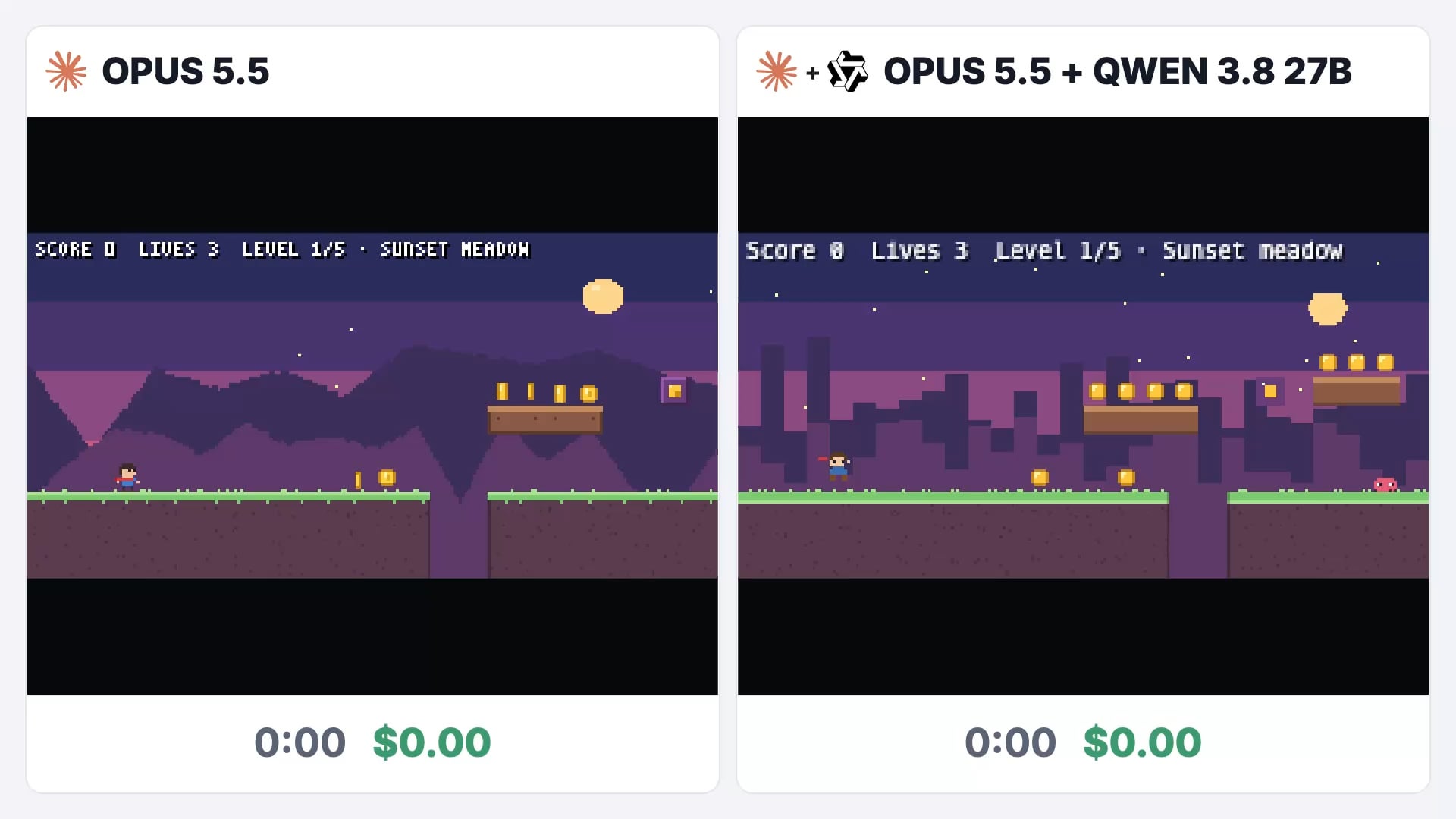
A recent practitioner report published on the r/ClaudeAI forum details an experiment comparing two artificial intelligence architectures for automated software generation. The author constructed the same application—a five-level pixel-art platformer game derived from a single specification—using two distinct configurations on a MacBook Pro equipped with an M5 Max processor. Both configurations utilized a platform identified as Atomic Agent operating in what the author terms Fusion mode. The first configuration employed Opus 5.5 alone, executing the standard iterative loop of planning, coding, and reviewing. The second configuration divided these labor functions: Opus 5.5 was restricted to planning and code review, while a locally hosted Qwen 3.8 27B parameter model was tasked exclusively with writing the code. The reported results indicate that the single-model approach required sixteen minutes to complete the build at a cost of $2.52. The hybrid approach required forty-two minutes but reduced the financial cost to $0.62. The author attributes the higher expense of the single-model approach to output tokens, noting that the majority of the Opus bill resulted from the frontier model typing out every line of code rather than from its reasoning processes.
This result illustrates a practical instantiation of architectural role separation in multi-model systems, where computationally expensive frontier models are reserved for high-level orchestration and evaluation, while less expensive local models handle voluminous token generation. The mechanism driving the cost reduction is straightforward: frontier models typically charge premium rates per token for both input and output. Because software generation requires the production of extensive boilerplate and syntactic structures, delegating this high-volume output to a local model eliminates the per-token marginal cost associated with cloud-hosted inference. The local Qwen 3.8 27B model, running entirely on the user's hardware, incurs no API billing for its generated tokens. Conversely, the mechanism driving the increased latency in the hybrid model likely involves inter-process communication overhead. Passing plans from the frontier model to the local model, generating the code, and subsequently returning that code to the frontier model for review introduces sequential dependencies and context-switching delays that do not exist when a single model maintains continuous internal state.
The limits of this evidence must be carefully delineated before extrapolating to broader educational or institutional contexts. First, the data originates from a single practitioner report rather than a controlled, peer-reviewed study. The sample size is one task executed twice, which precludes statistical generalization. Second, the specific hardware environment—a MacBook Pro M5 Max—provides substantial local compute resources that may not be representative of standard student or institutional devices. The performance of the 27-billion parameter Qwen model is heavily dependent on memory bandwidth and neural engine capabilities; on less capable hardware, the forty-two-minute completion time could increase dramatically, potentially negating the workflow's viability. Third, the equivalence of the outputs is asserted but not rigorously validated. While both configurations produced the requested five-level platformer, the report does not detail whether the code quality, maintainability, or bug frequency were identical across the two builds. It remains possible that the cheaper, slower method produced inferior code that nonetheless satisfied the basic prompt requirements.
Despite these evidentiary constraints, the architectural principle demonstrated holds significant implications for teaching and learning with AI, particularly in computer science education and project-based learning environments. When students utilize generative AI for programming assignments, the financial cost of API usage frequently acts as a barrier to iterative experimentation. If educational institutions adopt or teach hybrid workflows—where a cloud-based model handles architectural planning and logic verification while a local model generates syntax—the economic barrier to sustained interaction is substantially lowered. This enables students to engage in more frequent iteration cycles without incurring prohibitive costs.
Furthermore, separating the planning function from the coding function aligns with established pedagogical goals in computing education. A persistent challenge in AI-assisted programming courses is that students may use frontier models to bypass the conceptual work of system design, treating the AI merely as a code-generation oracle. By structuring the AI toolchain such that the frontier model only plans and reviews, educators can force students to interact primarily with the architectural reasoning layer. The student must evaluate the plan proposed by the frontier model before the local model executes it, thereby centering the learning experience on system design, algorithmic thinking, and code review rather than mere syntax production. The local model becomes a mechanical typist executing a verified blueprint, reducing the temptation to rely on AI for conceptual problem-solving.
However, the latency trade-off observed in the report presents a distinct pedagogical challenge. In instructional settings, prolonged wait times can disrupt the flow of learning and diminish student engagement. A process that takes forty-two minutes instead of sixteen requires careful curricular integration. Educators would need to design asynchronous activities or parallel tasks to occupy the waiting period productively, ensuring that the delay does not translate into lost instructional time. Additionally, the requirement for high-end local hardware to run a 27-billion parameter model efficiently raises equity concerns. If this hybrid approach is integrated into coursework, institutions must ensure that all students have access to machines capable of supporting the local inference without severe performance degradation, lest the cost-saving measure inadvertently create a new technological divide based on hardware access.

Ultimately, this practitioner observation highlights a maturing ecosystem in which AI deployment for technical tasks is shifting from monolithic model reliance toward specialized, distributed architectures. For educational technology researchers and practitioners, the transition from evaluating single-model capabilities to analyzing multi-model orchestration represents a necessary evolution in understanding how AI tools will practically function in resource-constrained learning environments.
Source: Same game built twice: Opus alone vs Opus planning + local Qwen coding