
Field notes · November 8, 2026
Context Summarization in Agentic Coding Interfaces
Anthropic’s Claude Code introduced automatic summarization of idle long-context sessions to prevent redundant token transmission after cache expiration. This log examines the mechanism and its implications for sustained human-AI interaction
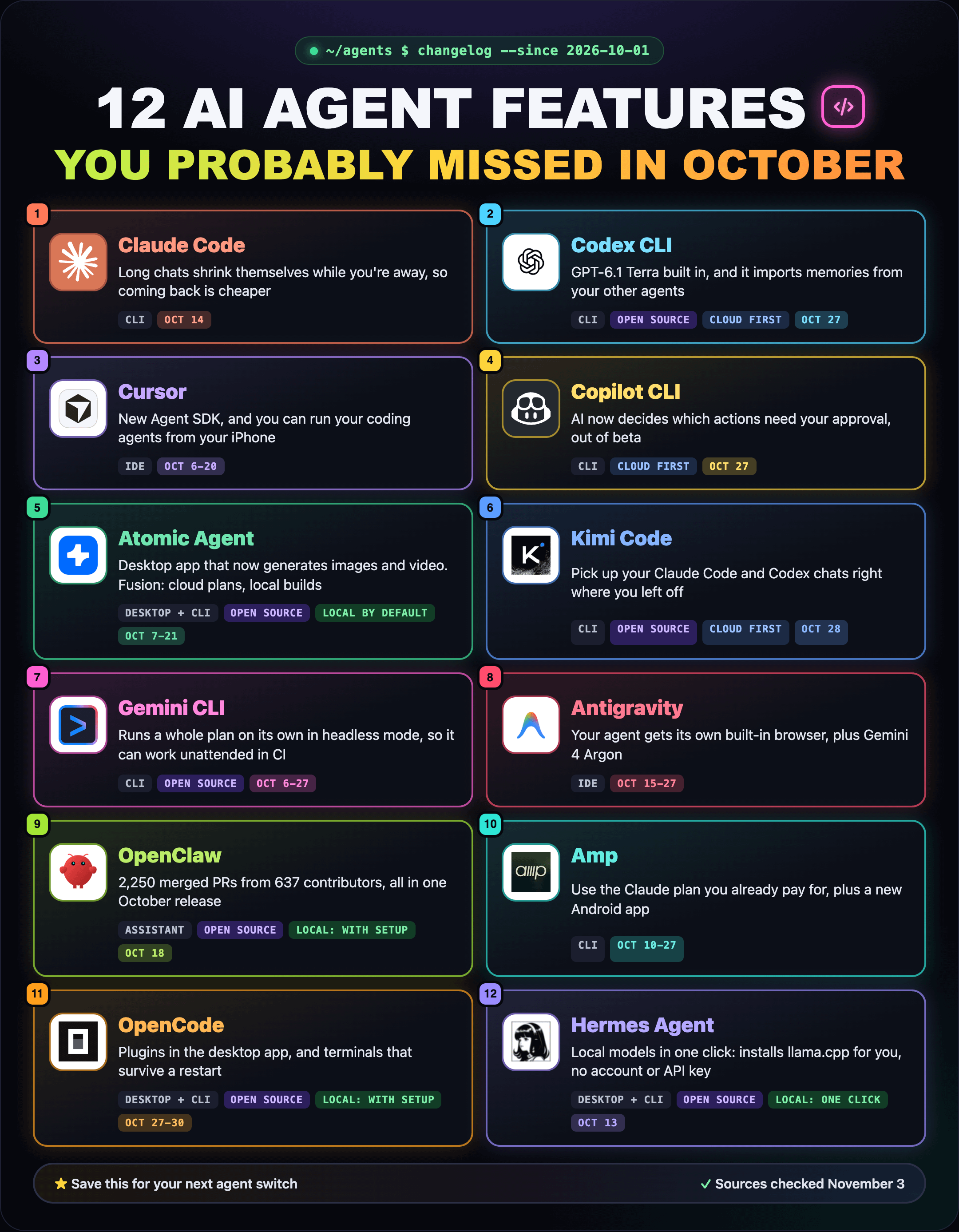
According to a community-curated roundup of artificial intelligence agent releases published on the r/GeminiAI subreddit, Anthropic deployed twenty-six distinct releases of its agentic coding tool, Claude Code, during October. The source document highlights one specific functional addition detailed in the project’s public changelog: when a user leaves an extended conversational session idle and the underlying context cache expires, the system now automatically summarizes the prior interaction. This summarization ensures that resuming the session does not require the retransmission of more than two hundred thousand tokens to the model. The feature was documented in the official changelog hosted on GitHub at anthropics/claude-code. The Reddit post frames this update within a broader landscape of rapid iterative releases across multiple AI agents during the same month, but isolates the context-summarization behavior as the singular development of primary significance for users managing extensive agentic workflows.
The mechanism underlying this feature addresses a fundamental constraint in the architecture of large language models: the finite and computationally expensive nature of context windows. When an agentic system engages in a prolonged task—such as writing, debugging, or refactoring a complex software codebase—the accumulated dialogue history grows substantially. To maintain low latency and reduce computational overhead during active work, inference providers typically employ prompt caching, storing the tokenized representation of the conversation prefix so it need not be recomputed with every subsequent turn. However, these caches are ephemeral. If a user pauses their work and the cache time-to-live expires, the system faces a binary choice upon resumption: either discard the history entirely, forcing the user to manually reconstruct the state of the project, or resend the entire un-cached transcript. For a session exceeding two hundred thousand tokens, the latter option incurs severe latency penalties and significant financial cost, as pricing is directly proportional to input token volume.
Automatic context summarization resolves this dilemma through lossy compression. Rather than transmitting the verbatim transcript, the system generates a condensed representation of the session’s state, decisions, and outstanding tasks. This summary is then injected as the new system prompt or initial context when the user returns. The theoretical basis for this approach relies on the distinction between episodic detail and semantic state. While the exact phrasing of earlier turns is discarded, the functional requirements, architectural decisions, and current variables are preserved. This represents a shift from treating the context window as a pristine historical record to treating it as a dynamic working memory buffer that can be actively managed and compressed by the system itself.
The limits of the evidence presented in the changelog must be acknowledged. The documentation confirms the existence of the summarization trigger and its intended purpose—avoiding the cost of resending two hundred thousand tokens—but it does not provide empirical data regarding the fidelity of the resulting summaries. Lossy compression inherently risks information degradation. In software engineering, omitting a specific edge case discussed early in a session, or failing to capture a nuanced constraint agreed upon between the human and the agent, could lead to downstream errors. Furthermore, the changelog entry does not specify whether the user has agency in reviewing or editing the generated summary before it becomes the foundational context for the resumed session. Without transparency into the compression algorithm’s failure modes, the reliability of this feature in mission-critical environments remains theoretically sound but empirically unverified by the cited source alone.
When translating this mechanism to teaching and learning with AI, particularly in computer science education or any discipline utilizing agentic tools for complex problem-solving, the implications are substantial. Educational interactions with AI frequently involve long, iterative dialogues where a student and an AI tutor collaboratively build understanding or construct an artifact over hours or days. If a student steps away from a programming assignment and returns after the platform’s cache has expired, the traditional penalty is a loss of continuity. The student must either pay a premium—in institutional compute budgets or personal subscription costs—to restore the full context, or they must begin again, losing the pedagogical thread of the previous session.
Automatic summarization mitigates this friction, supporting sustained engagement without prohibitive resource expenditure. From a theoretical standpoint, this aligns with models of distributed cognition, where the cognitive burden of maintaining task state is offloaded from the human learner to the technological environment. By preserving the semantic state of the learning interaction, the AI acts as a reliable external memory store that manages its own capacity constraints transparently. This allows the learner to focus cognitive resources on the novel aspects of the problem rather than on reconstructing the parameters of the previous session.

However, educators must consider the pedagogical consequences of lossy context compression. In a learning environment, the process of articulating and revisiting prior reasoning is often where deep understanding is consolidated. If the AI silently compresses a student’s exploratory dialogue into a brief summary, the student may lose access to their own developmental trajectory, including productive mistakes and the reasoning paths that led to corrections. Therefore, while the mechanism solves an infrastructural bottleneck regarding token limits and cache expiration, its deployment in educational settings requires careful interface design. Systems should ideally expose the summarized state to the learner, allowing them to verify that critical conceptual milestones have been preserved before continuing the collaborative task. This ensures that the efficiency gains of automated context management do not inadvertently undermine the reflective practices essential to durable learning.