
Field notes · October 20, 2026
Consumer GPU Adaptation for Mixture-of-Experts Audio Models
A community-developed adapter enables a 35-billion-parameter mixture-of-experts speech model to run on consumer-grade AMD hardware by offloading inactive experts to system memory. This development illustrates how architectural sparsity can
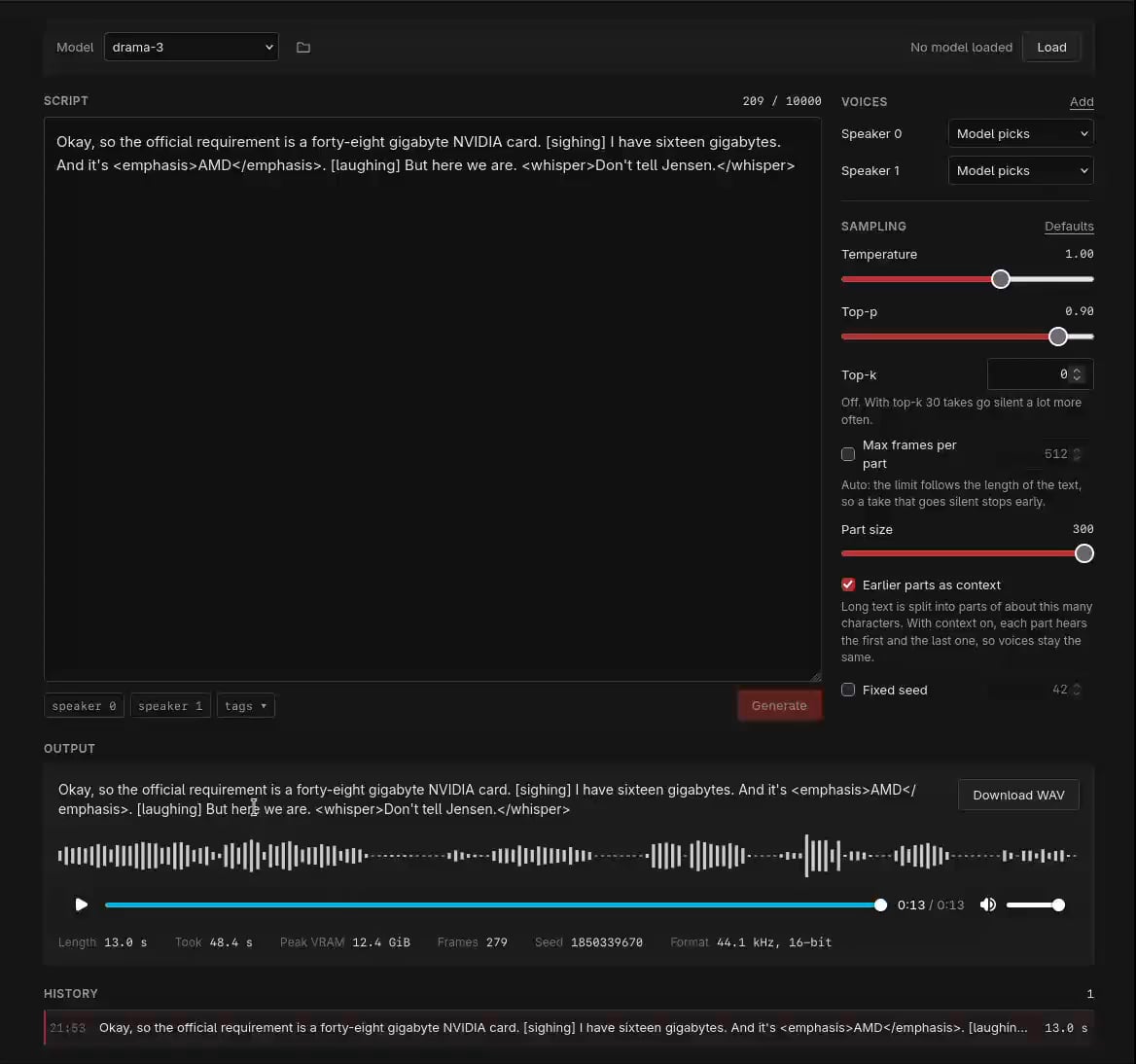
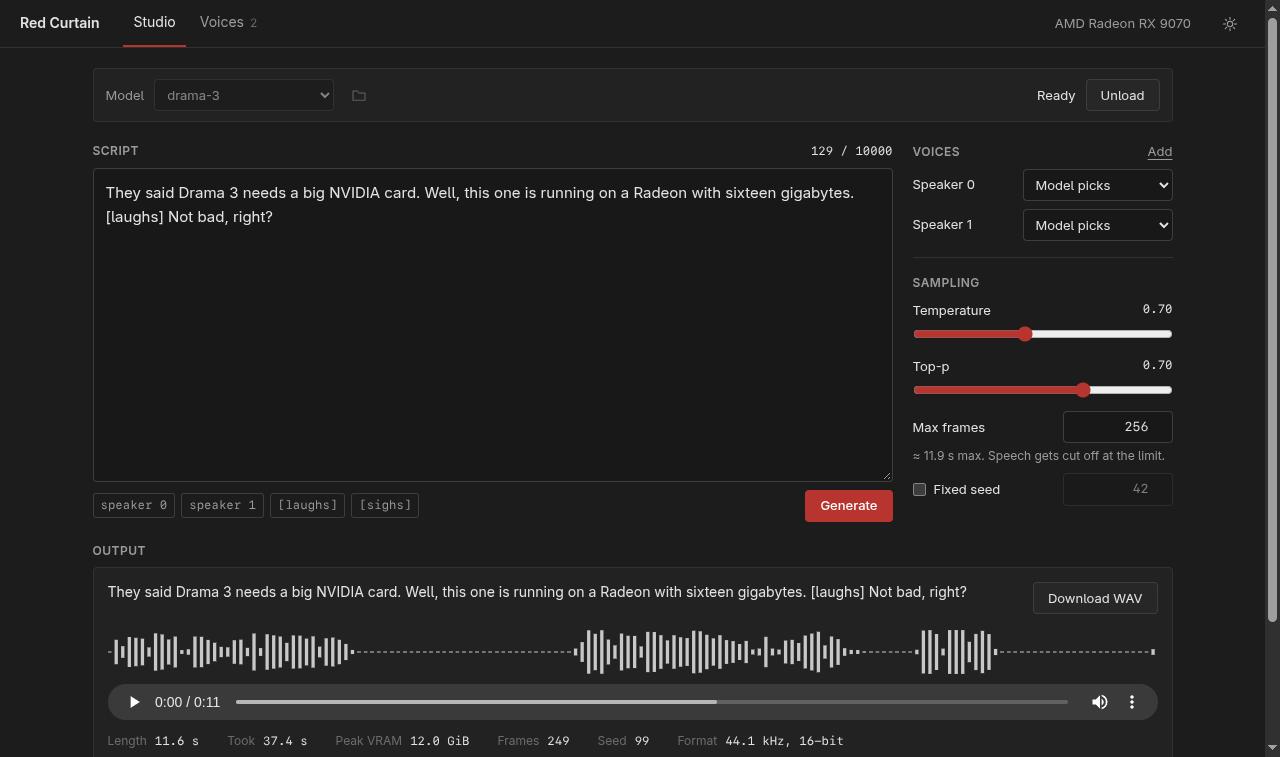
A recent discussion on the r/LocalLLaMA forum documents an independent engineering effort to run Fish Audio’s Drama 3 text-to-speech model on consumer hardware that falls significantly below the developer’s stated requirements. According to the source, Fish Audio officially specifies that Drama 3 requires an NVIDIA graphics processing unit equipped with 48 gigabytes of video memory. The author of the post, operating with a 16-gigabyte AMD Radeon RX 9070, reports developing a software adapter named Red Curtain—hosted at github.com/re133/red-curtain—in collaboration with the AI assistant Claude. The source details that Drama 3 is architected as a 35-billion-parameter mixture-of-experts (MoE) model, wherein approximately 3 billion parameters are active per generated token. The adapter functions by retaining the FP8-quantized expert weights, which occupy roughly 32 gigabytes, in system random-access memory rather than attempting to load them entirely into the GPU. Only the specific experts activated during inference are cached onto the 16-gigabyte AMD card, while all other operations execute in BF16 precision directly on the GPU. The author reports a model loading time of approximately 17 seconds and states that generating 3.3 seconds of speech audio requires roughly 13 seconds of compute time on this configuration.
The theoretical mechanism underlying this adaptation relies on the inherent conditional computation properties of mixture-of-experts architectures. Unlike dense neural networks, where every parameter participates in the forward pass for every input token, MoE models route each token through a sparse subset of specialized sub-networks, or experts. In the case of Drama 3, only about 8.5 percent of the total 35 billion parameters are active for any given token. This structural sparsity means that the instantaneous memory bandwidth and capacity demands are dictated by the active parameter count—approximately 3 billion—rather than the total parameter count. The Red Curtain adapter exploits this property by treating system RAM as a high-latency reservoir for dormant experts. When the routing mechanism selects a particular expert for activation, that expert’s FP8-compressed weights are transferred across the PCIe bus into the GPU’s VRAM. Because the active footprint is small relative to the 16-gigabyte capacity of the Radeon RX 9070, the remaining VRAM is sufficient to handle the BF16 activations and intermediate tensors required for synthesis.
However, the evidence presented in the source carries notable limitations. The performance metrics are derived from a single user’s self-reported experience on one specific hardware configuration, lacking the controlled benchmarking, variance reporting, or peer review associated with formal computer science research. The reported generation speed—13 seconds of compute for 3.3 seconds of audio output—indicates a real-time factor of approximately four, meaning the model generates speech substantially slower than real time. This latency is likely attributable to the bottleneck introduced by continuously paging expert weights from system RAM over the PCIe interface, a process vastly slower than reading from native VRAM. Furthermore, the reliance on FP8 quantization for the stored experts may introduce numerical precision degradation compared to running the model in its original format on the recommended 48-gigabyte NVIDIA hardware, though the source does not provide perceptual quality evaluations or objective audio fidelity metrics to quantify this potential loss. Finally, the use of an AI assistant to write the adapter code introduces questions regarding the long-term maintainability and security auditing of the resulting software artifact.
Despite these evidentiary limits, the successful execution of a 35-billion-parameter generative audio model on a 16-gigabyte consumer GPU holds tangible implications for teaching and learning with artificial intelligence. High-fidelity text-to-speech models possess significant utility in educational contexts, including the generation of accessible audio materials for visually impaired students, the creation of multilingual listening exercises for language acquisition, and the rapid prototyping of narrative content in digital storytelling curricula. Historically, deploying models of this scale has required access to institutional computing clusters or expensive cloud-based API subscriptions, effectively centralizing control and limiting student experimentation. By demonstrating that architectural sparsity can be leveraged to bypass enterprise hardware mandates, projects like Red Curtain suggest a pathway toward localized, offline deployment of advanced generative models on standard laboratory or personal computers.
This decentralization alters the pedagogical dynamics of AI integration. When students and educators can run sophisticated models locally, they transition from being mere consumers of opaque, remotely hosted services to active operators of transparent systems. Local execution eliminates network latency dependencies and data privacy concerns associated with transmitting prompts to external servers, which is particularly relevant when handling sensitive educational data. Moreover, the process by which the adapter was created—using an AI coding assistant to bridge a hardware compatibility gap—serves as a practical exemplar of computational problem-solving. It demonstrates to learners how understanding a model’s underlying architecture, such as the distinction between total and active parameters in an MoE framework, can be translated into actionable engineering solutions. While the current inference speeds reported in the source remain too slow for seamless interactive applications, the proof of concept establishes that hardware constraints for large-scale educational AI tools are not absolute, but are instead engineering challenges subject to algorithmic optimization and architectural exploitation.
Source: Fish Audio Drama 3 says it needs a 48 GB NVIDIA card. My 16 GB Radeon disagrees.