
Field notes · October 12, 2026
Automating Local LLM Configuration: The llm-tune Project and Educational AI
The open-source project llm-tune automates the discovery of optimal inference settings for local large language models across diverse hardware architectures. This research log examines its mechanisms, evidentiary limits, and implications fo
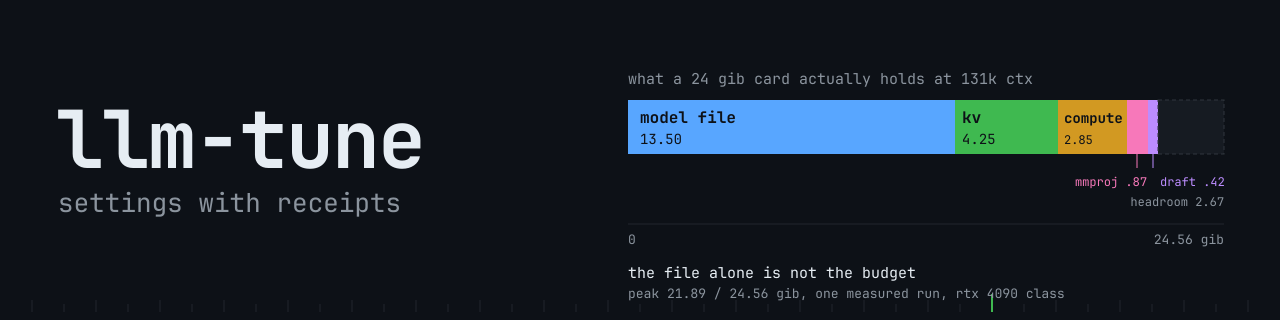
A recent contribution to the r/LocalLLaMA community introduces llm-tune, an open-source project designed to automate the identification of optimal configuration settings for running local large language models (LLMs) on specific hardware. According to the project’s GitHub repository and the author’s accompanying post, llm-tune is intended to help users determine the best parameters for their particular computational setups. The developer explicitly notes that the project is still under active development and invites community feedback and benchmark results to expand testing across a wider variety of GPU configurations. In terms of technical scope, the source states that llm-tune currently supports dense model architectures, Mixture of Experts (MoE) architectures, and hybrid MoE/Mamba architectures. Furthermore, the tool is designed to be hardware-agnostic within certain boundaries, supporting NVIDIA, AMD, and Intel Arc GPUs, as well as Apple Silicon processors. By abstracting the complexity of hardware-specific tuning, the project aims to make local LLM deployment more accessible to users who may lack deep systems engineering expertise.
From a theoretical standpoint, the mechanism underlying llm-tune addresses a fundamental challenge in applied machine learning: the highly variable performance of transformer-based and state-space models across heterogeneous hardware. Running an LLM locally requires navigating a complex parameter space that includes quantization levels, context window sizes, batch processing limits, memory offloading strategies, and backend-specific optimizations such as CUDA kernel selection or Metal Performance Shaders configurations. Dense architectures distribute computation uniformly across all parameters, whereas MoE models route tokens through specialized expert sub-networks, creating irregular memory access patterns that demand different optimization strategies. Hybrid architectures incorporating Mamba layers introduce state-space modeling, which alters the computational graph and memory requirements further. A tool like llm-tune presumably operates by systematically exploring this multidimensional configuration space—likely through heuristic search, grid sampling, or Bayesian optimization—to identify parameter combinations that maximize throughput (tokens per second) or minimize latency without exceeding the physical memory constraints of the host device.
However, the evidence supporting the efficacy of llm-tune remains strictly limited at this stage. The primary constraint is the project's early developmental status, as acknowledged by the creator. The current claims of cross-platform support for NVIDIA, AMD, Intel Arc, and Apple Silicon rely on preliminary implementations rather than comprehensive, peer-reviewed benchmarking data. Because the developer is actively soliciting community feedback and benchmark results to test across more GPU setups, the empirical foundation is inherently crowdsourced and unstandardized. There is no published data detailing the variance in performance gains achieved through llm-tune compared to manual tuning or default configurations. Furthermore, the interaction effects between specific model weights, quantization formats (such as GGUF, EXL2, or AWQ), and distinct hardware drivers are notoriously difficult to generalize. Without rigorous, controlled benchmarking across standardized tasks, the reliability of the automated configurations remains theoretically sound but empirically unverified. The reliance on community-sourced testing also introduces selection bias, as contributors are likely to submit results from high-end or popular consumer hardware, potentially leaving edge cases and older enterprise equipment underrepresented.
Despite these evidentiary limitations, the conceptual trajectory of projects like llm-tune carries significant implications for teaching and learning with artificial intelligence. The deployment of AI in educational settings is frequently bottlenecked by two competing pressures: the need for data privacy and the requirement for reliable system performance. Cloud-based AI services offer seamless user experiences but necessitate transmitting student interactions, queries, and potentially sensitive academic records to external servers. Local LLM deployment resolves this privacy concern by ensuring that all data generation and processing occur entirely on institutional or personal hardware. Yet, the technical barrier to achieving performant local inference has historically been prohibitive for educators, instructional designers, and students who are not computer scientists.
If automated tuning tools mature and prove reliable, they could fundamentally lower the barrier to entry for localized educational AI. Teachers seeking to deploy a specialized tutoring agent, a writing assistant, or a coding companion would no longer need to manually debug out-of-memory errors or experiment with esoteric command-line flags. By automating the alignment between a chosen pedagogical model—whether a dense instruction-tuned model or a highly efficient MoE variant—and the available classroom hardware, tools like llm-tune bridge the gap between AI capability and practical usability. This is particularly relevant for institutions operating with heterogeneous device fleets, where a mix of Apple Silicon laptops, AMD-powered desktop labs, and legacy NVIDIA workstations must all run the same educational software stack reliably.
Moreover, the architectural diversity supported by the project aligns with emerging trends in educational technology. MoE and hybrid Mamba models are increasingly favored for local deployment because they offer high reasoning capabilities with lower active parameter counts, thereby reducing the computational burden during inference. For learning applications that require long context windows—such as analyzing entire student essays or maintaining extended Socratic dialogues—the efficient memory management facilitated by proper tuning is essential. If an automated tool can reliably configure these advanced architectures for local execution, it enables the design of AI learning environments that are both highly capable and entirely private.
In conclusion, while llm-tune currently represents an early-stage effort requiring substantial empirical validation, its underlying premise addresses a critical infrastructural need. The transition of generative AI from cloud-dependent services to locally hosted, privacy-preserving tools in education depends heavily on solving the hardware-software optimization problem. Projects that systematically automate this tuning process hold the potential to democratize access to performant local AI, provided they eventually deliver the robust, standardized benchmarking necessary to earn institutional trust.
Source: llm-tune: getting local models that actually perform