
Field notes · October 24, 2026
API Key Harvesting on Railway and Educational AI Security
A security incident on the Railway hosting platform exposed user API keys, including those for Anthropic's Claude, to unauthorized harvesting. This event highlights critical infrastructure vulnerabilities for educators deploying custom AI a
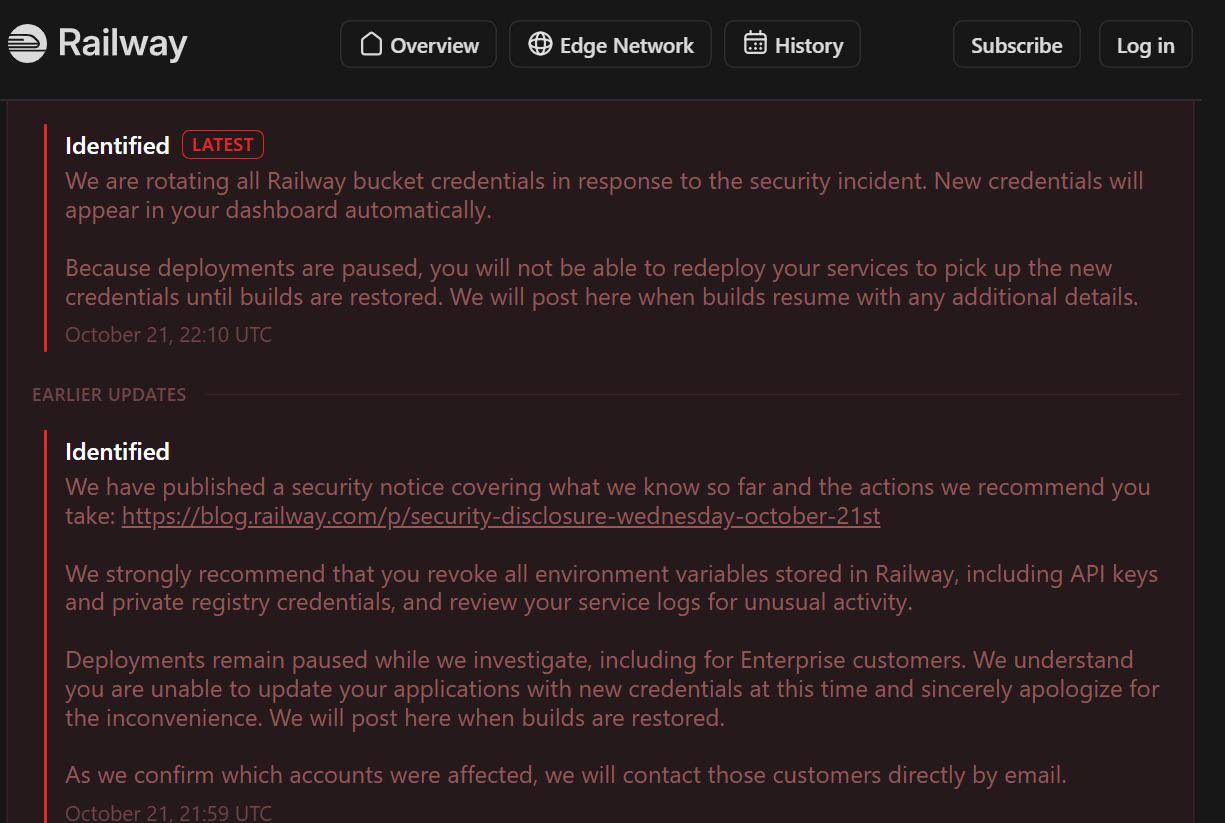
A recent security incident involving the cloud hosting platform Railway has drawn attention to the vulnerabilities inherent in managing application programming interface (API) keys for large language models. According to a discussion thread on the r/ClaudeAI subreddit, users were advised to disable any API keys utilized within Railway-hosted applications due to active harvesting of those credentials. The official Railway status page at https://status.railway.com/ corroborates that an incident occurred, prompting warnings across the developer community. Within the Reddit thread, which generated seven comments, one user reported that a Claude API key stored in Railway’s environment variables was compromised. The user noted that the unauthorized usage resulted in approximately eighty dollars in charges before Anthropic’s internal monitoring systems detected the anomalous activity and disabled the user’s automatic reload feature, thereby preventing further financial loss. The primary sources for this event are the community reports on Reddit and the official status updates provided by Railway.
The mechanism underlying this incident involves the compromise of environment variables within a platform-as-a-service (PaaS) architecture. When developers deploy applications that interact with external AI services, such as Anthropic’s API, they typically store authentication credentials as environment variables rather than hardcoding them into the application source. This practice is intended to separate sensitive configuration data from the application logic. However, if the hosting infrastructure itself is breached, or if a vulnerability exists in how the platform isolates and secures these variables, malicious actors can extract them en masse. Once an API key is harvested, it functions as a bearer token; any party possessing the key can issue requests to the API provider, consuming the original owner’s allocated compute quota and financial resources until the key is revoked or the provider intervenes.
The evidence surrounding this specific incident is primarily anecdotal and community-sourced, which introduces certain limitations. The report of the eighty-dollar loss relies on a single user’s account on a public forum, meaning the total scale of the breach—how many keys were harvested, the aggregate financial damage, or the precise technical vector exploited within Railway’s infrastructure—remains unquantified in the available public record. Furthermore, while the Railway status page confirms an operational incident, the exact nature of the vulnerability, whether it stemmed from a misconfiguration, an insider threat, or an external exploit, is not detailed in the cited notes. Consequently, the theoretical analysis must proceed with the understanding that the incident demonstrates a confirmed class of vulnerability (credential exposure via PaaS compromise) even if the epidemiological scope of this specific outbreak is incompletely documented.
This incident carries significant implications for teaching and learning environments where artificial intelligence is deployed through custom infrastructure. In contemporary educational technology, there is a growing movement among institutions and individual educators to host bespoke AI agents, tutoring interfaces, or assessment tools using platforms like Railway, Render, or Heroku. These deployments often rely on commercial APIs, such as those provided by Anthropic or OpenAI, to power the underlying language models. Educators and instructional technologists frequently operate outside the protective perimeter of enterprise-grade cybersecurity teams, managing their own API keys and billing accounts to prototype or run classroom tools.
When an API key used for an educational application is harvested, the consequences extend beyond immediate financial loss. First, there is the risk of service disruption. If an automated billing safeguard, such as the one triggered by Anthropic in the reported case, disables the API access, the educational tool relying on that key will instantly cease to function. For a teacher utilizing a custom AI agent to facilitate student inquiry or provide formative feedback during a lesson, this sudden outage represents a critical failure in instructional continuity. The pedagogical flow is interrupted, and trust in the technological medium is degraded.
Second, compromised API keys introduce severe data privacy and security risks. A malicious actor utilizing a harvested key might not only consume compute credits but could potentially interact with the application’s endpoints. If the educational application is poorly architected and does not enforce strict separation between the API credential and the application’s data layer, unauthorized access to student interactions, submitted work, or personal information becomes a tangible threat. Educational institutions are bound by stringent data protection regulations, and a breach originating from a third-party hosting platform’s failure to secure environment variables could result in significant compliance violations.
Third, this event underscores a gap in the professional preparation of educators who integrate AI into their practice. The assumption that storing keys in environment variables constitutes sufficient security is a baseline software engineering principle, but it fails when the platform managing those variables is compromised. Educators acting as de facto system administrators require training not only in prompt engineering or pedagogical integration but also in fundamental infrastructure security. This includes implementing key rotation schedules, setting strict programmatic spending limits directly within the API provider’s dashboard rather than relying solely on auto-reload shutoffs, and utilizing dedicated, low-limit API keys for experimental or classroom-facing deployments rather than reusing keys tied to primary institutional or personal billing accounts.
Ultimately, the Railway API key harvesting incident serves as a practical demonstration that the efficacy of AI in education is inextricably linked to the reliability and security of its underlying infrastructure. Theoretical models of AI-assisted learning often abstract away the physical and digital logistics of deployment, treating the AI as a frictionless cognitive partner. However, as this incident illustrates, the material reality of hosting these systems introduces vulnerabilities that can abruptly terminate the educational intervention. Ensuring robust security practices at the infrastructure level is therefore not merely an IT concern, but a prerequisite for the stable and safe integration of artificial intelligence into learning environments.