
Field notes · October 29, 2026
API Credits for ChatGPT Subscribers and Institutional AI
OpenAI now provides up to $500 in monthly API credits to ChatGPT Pro and Business subscribers, altering the economic calculus for educational institutions integrating generative AI. This log examines the structural implications of bundling
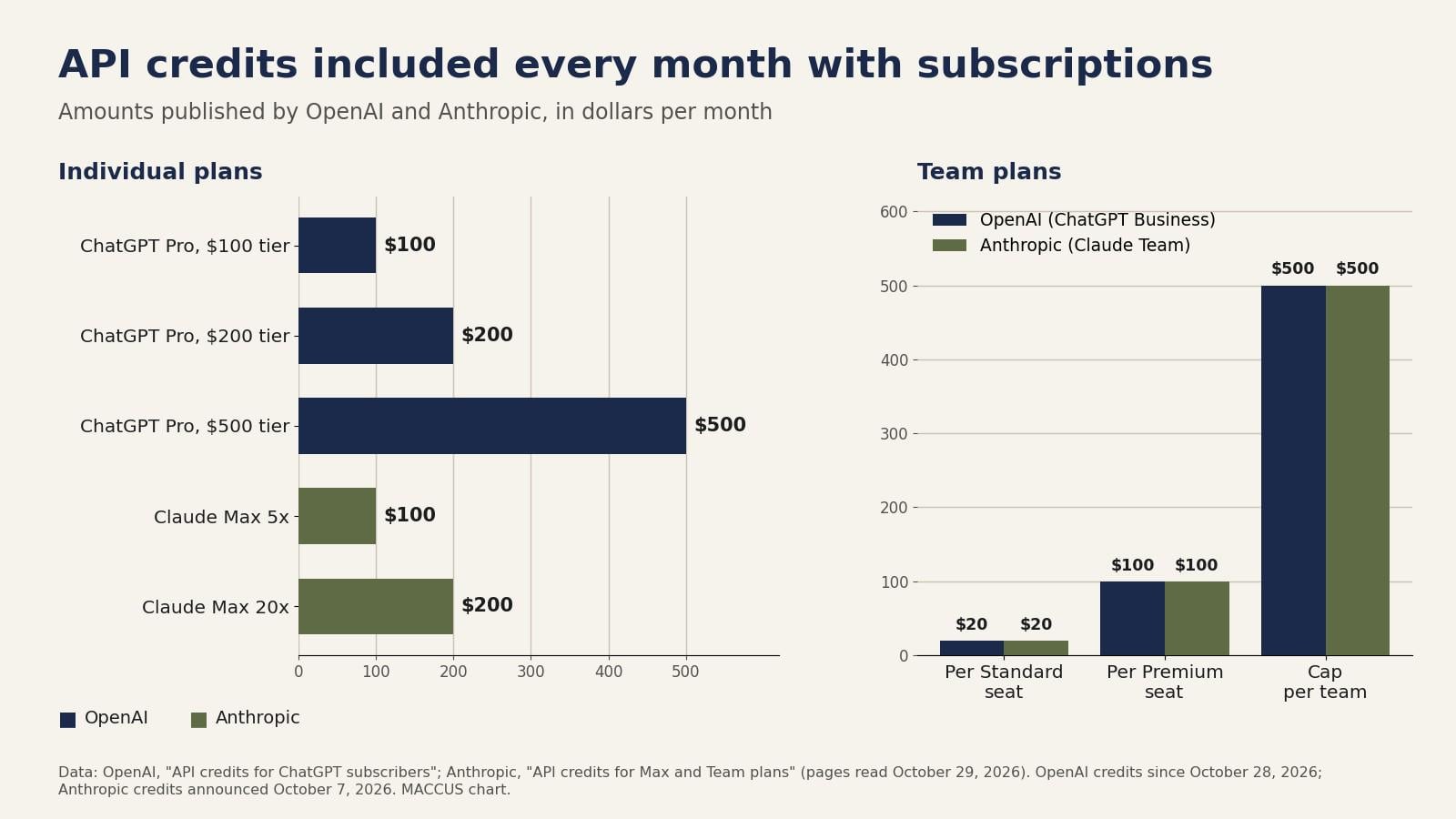
A recent report indicates that OpenAI has introduced a new benefit structure for its paid subscription tiers, specifically targeting ChatGPT Pro and Business users. According to the source published by Maccus, these subscribers are now eligible to receive up to $500 per month in API credits. The announcement, which surfaced on community platforms such as r/OpenAI, generated immediate enthusiasm among users who view the additional usage allocation as a significant advantage for their workflows. The provision effectively bridges the gap between the consumer-facing chat interface and the programmatic access typically reserved for developers paying separately for token consumption. By attaching substantial API credits to existing subscription plans, OpenAI is restructuring how individuals and organizations access its underlying models for custom applications.
The mechanism driving this policy shift operates at the intersection of platform economics and developer ecosystem cultivation. Historically, access to large language model APIs required distinct financial commitments separate from consumer chat interfaces. Users building custom tools, automating workflows, or conducting research had to fund API usage directly based on token consumption, creating a financial barrier between casual interaction and programmatic integration. By bundling up to $500 in monthly API credits with Pro and Business subscriptions, OpenAI reduces the marginal cost of experimentation and deployment for subscribers. This mechanism functions as a cross-subsidization strategy: the fixed revenue from high-tier subscriptions funds variable API compute costs, encouraging users to transition from passive consumers of a chat interface to active builders of AI-integrated systems. For Business subscribers, which often represent teams or institutional units, this credit pool can be allocated across multiple projects, effectively lowering the total cost of ownership for deploying AI solutions within an organization.
However, the limits of the available evidence require careful academic scrutiny. The primary source material consists of a brief web report and anecdotal reactions from a community forum, lacking detailed documentation regarding the precise terms of service governing these credits. It remains unclear whether the $500 figure represents a hard cap, a tiered maximum dependent on specific billing cycles, or a promotional limit subject to revision. Furthermore, the technical constraints applied to these bundled credits—such as rate limits, model availability (e.g., whether the credits apply equally to standard and reasoning models), and data retention policies—are not specified in the cited material. Community reactions, while indicative of user sentiment, reflect individual enthusiasm rather than systematic analysis of institutional utility. Consequently, any theoretical projection regarding the impact of these credits must acknowledge that the operational parameters defining their use remain partially opaque. Without official, granular documentation from OpenAI detailing the architectural constraints of these credits, researchers and educators must treat the $500 figure as a nominal ceiling rather than a guaranteed baseline for computational planning.
When the link between subsidized API access and educational technology is examined, the implications for teaching and learning become structurally significant. In higher education and advanced research environments, the cost of API tokens frequently dictates the scope of pedagogical innovation. When computer science departments, digital humanities programs, or instructional design teams wish to build custom AI agents, automated grading rubrics, or specialized tutoring interfaces, they must navigate institutional procurement processes to secure API funding. The introduction of up to $500 in monthly credits via a Business subscription alters this dynamic. An institutional unit holding a ChatGPT Business license can potentially redirect those credits toward developing bespoke educational tools without requiring supplementary departmental budgets. This shifts the economic architecture of educational AI from a centralized, heavily gated resource to a more distributed capability, empowering individual faculty members or small research groups to prototype software that interacts programmatically with frontier models.
This economic shift also influences the pedagogical design of courses centered on artificial intelligence. In disciplines where students are expected to learn prompt engineering, application programming interface integration, or the development of autonomous agents, the cost of iterative testing is a known constraint. Students learning to build AI-driven applications often exhaust free tiers rapidly, and institutional sandbox environments may impose strict rate limits that hinder deep exploration. If an educational institution leverages Business-tier API credits to fund student sandboxes, the friction associated with trial-and-error learning in software development is substantially reduced. Students can engage in rapid prototyping, testing how variations in system prompts, temperature settings, or model architectures affect output quality without the anxiety of depleting a finite personal budget. This environment supports a pedagogy of experimentation, where the focus remains on understanding the behavior and limitations of large language models rather than optimizing for token conservation.
Moreover, the distinction between Pro and Business subscriptions suggests divergent pathways for educational adoption. Individual educators or independent researchers operating under a Pro subscription might utilize the credits to develop personal productivity tools, automate literature reviews, or generate customized instructional materials through programmatic pipelines. Conversely, the Business tier implies organizational deployment, where IT administrators can manage access, enforce data governance standards, and distribute the $500 credit pool across a department. For educational institutions prioritizing data privacy and administrative oversight, the Business tier offers a mechanism to integrate API-level capabilities while maintaining compliance with institutional policies—a critical consideration when handling student data or proprietary research.
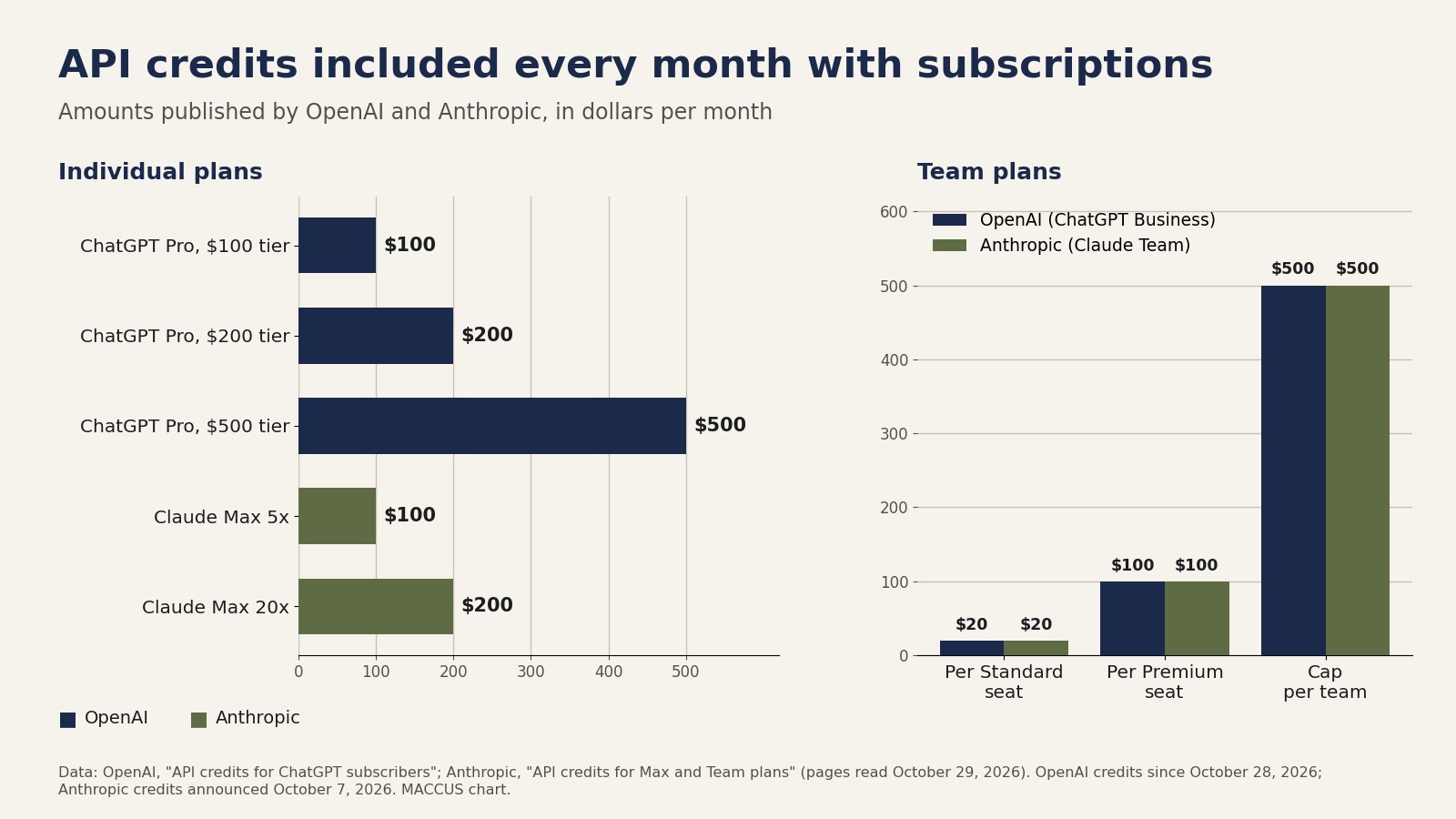
Ultimately, the provision of substantial API credits to subscribers represents a maturation in the commercial distribution of generative AI. It signals a transition from treating API access as a purely enterprise-grade commodity to embedding it within broader subscription ecosystems. For the field of educational technology, this development lowers the financial threshold for building custom AI integrations. While the empirical boundaries of these credits require further clarification from the provider, the structural implication is clear: the capacity to teach with, build upon, and research AI systems is becoming increasingly decoupled from direct, pay-per-token infrastructure costs, thereby expanding the potential for programmatic AI integration in diverse learning environments.
Source: OpenAI now gives ChatGPT Pro and Business subscribers up to $500 a month in API credits