
Field notes · October 17, 2026
Anthropic's Scion and the Displacement of Coding Bottlenecks
Anthropic reports that its custom version control system, Scion, processed over 30,000 merges in a single day after migrating away from Git. The company states that AI-driven coding has eliminated traditional software development bottleneck
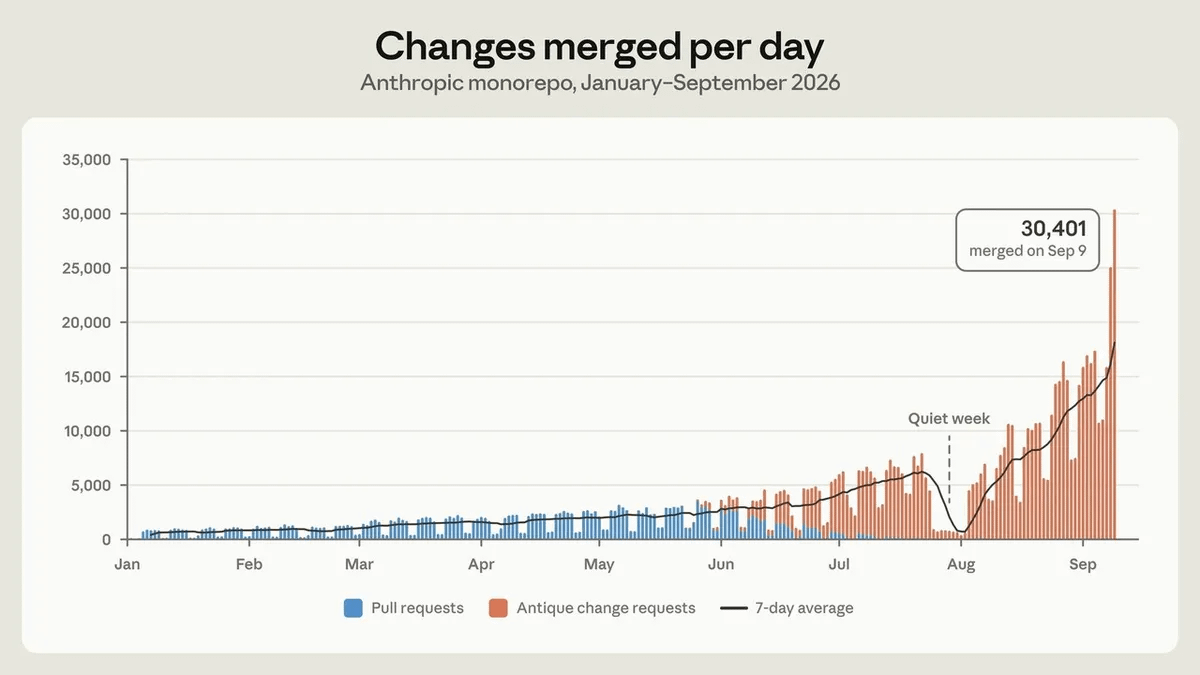
Anthropic recently published an engineering report detailing the development and deployment of Scion, a proprietary version control system built to replace Git within the organization’s infrastructure. According to the source, Anthropic utilized its own large language model, Claude, to construct this new system. The primary motivation for abandoning Git was the inability of existing distributed version control architectures to handle the volume and velocity of code generation produced by AI agents operating within the company. Anthropic reports that its internal monorepo achieved a throughput of more than 30,000 merges in a single day following the implementation of Scion. The company explicitly states that, within its operations, "coding is no longer the bottleneck to building systems or doing research." The report further asserts that Claude is capable of autonomously iterating on research loops, micro-optimizing complex programs, and building new services from the ground up at unprecedented speed and scale. This announcement, which generated significant discussion across technical forums, positions Anthropic as both a developer and a primary consumer of agentic AI systems capable of reshaping fundamental software engineering workflows.
The theoretical implications of this event are best understood through the lens of activity theory, specifically regarding the transformation of mediating artifacts and the shifting locus of constraints within a productive system. In traditional software engineering, the act of writing code and managing its integration via tools like Git constituted the primary mediating process between human intention and computational execution. The bottleneck was inherently tied to human typing speed, cognitive limits in tracking dependencies, and the manual resolution of merge conflicts. By introducing an AI agent capable of autonomous iteration and micro-optimization, Anthropic has fundamentally altered the mediating artifact. Code generation transitions from a deliberate, rate-limiting human action into an automated environmental condition. When the generative capacity of the AI exceeds the processing capacity of the underlying version control architecture, the constraint migrates downward in the technological stack—from the semantic layer of programming logic to the syntactic and structural layer of file management and merge algorithms. The creation of Scion represents an infrastructural adaptation necessitated by this upward shift in generative velocity.
However, the evidentiary limits of Anthropic’s claims require careful academic scrutiny. The assertion that coding is no longer a bottleneck originates from a corporate engineering blog post rather than a peer-reviewed empirical study. The metric provided—over 30,000 merges in a single day—quantifies throughput but does not independently verify the qualitative nature, complexity, or long-term stability of those merges. A high volume of automated commits could theoretically include trivial modifications, redundant iterations, or changes that introduce latent architectural debt, even if they resolve without immediate conflict. Furthermore, the claim that AI can autonomously iterate on research loops and build new services from the ground up describes internal operational observations at a single, highly resourced frontier AI laboratory. The generalizability of these observations to broader software engineering contexts, where domain knowledge is fragmented and legacy systems are prevalent, remains unproven. The evidence demonstrates that AI can accelerate code production beyond the limits of legacy tooling within a specific, controlled environment, but it does not yet establish that the conceptualization, validation, and systemic integration of complex software have been entirely decoupled from human oversight.
When translating these industrial developments to educational contexts, the displacement of the coding bottleneck carries profound implications for how computer science and computational thinking are taught. If the mechanical translation of logic into syntax is increasingly automated, pedagogical frameworks must pivot toward the competencies that govern and evaluate that automation. Activity theory suggests that as the mediating tool changes, the object of the activity and the division of labor must also be restructured. In educational settings, this implies a transition away from curricula heavily weighted toward syntax memorization and manual debugging, moving instead toward system design, architectural reasoning, and the critical evaluation of AI-generated outputs. Students must learn to operate at the level of the research loop itself—defining parameters, assessing the validity of autonomous iterations, and understanding the infrastructural limits of the systems executing their commands.

Moreover, Anthropic’s experience highlights a crucial lesson regarding tool literacy in education. The failure of Git to accommodate AI-generated code volumes illustrates that foundational tools are not immutable; they are subject to obsolescence when the surrounding activity system evolves. Teaching students to rely exclusively on current industry-standard tools without fostering an understanding of the underlying principles of version control, concurrency, and state management leaves them vulnerable to rapid technological shifts. Educational programs must therefore emphasize the theoretical underpinnings of computational infrastructure, enabling learners to adapt to or build new mediating artifacts as AI continues to alter the speed and scale of digital production. The ultimate educational takeaway from the Scion deployment is not merely that AI writes code faster, but that the acceleration of one node in a system inevitably generates friction at another, requiring practitioners who can diagnose and resolve systemic constraints rather than simply execute localized tasks.
Source: Redesigning Source Control